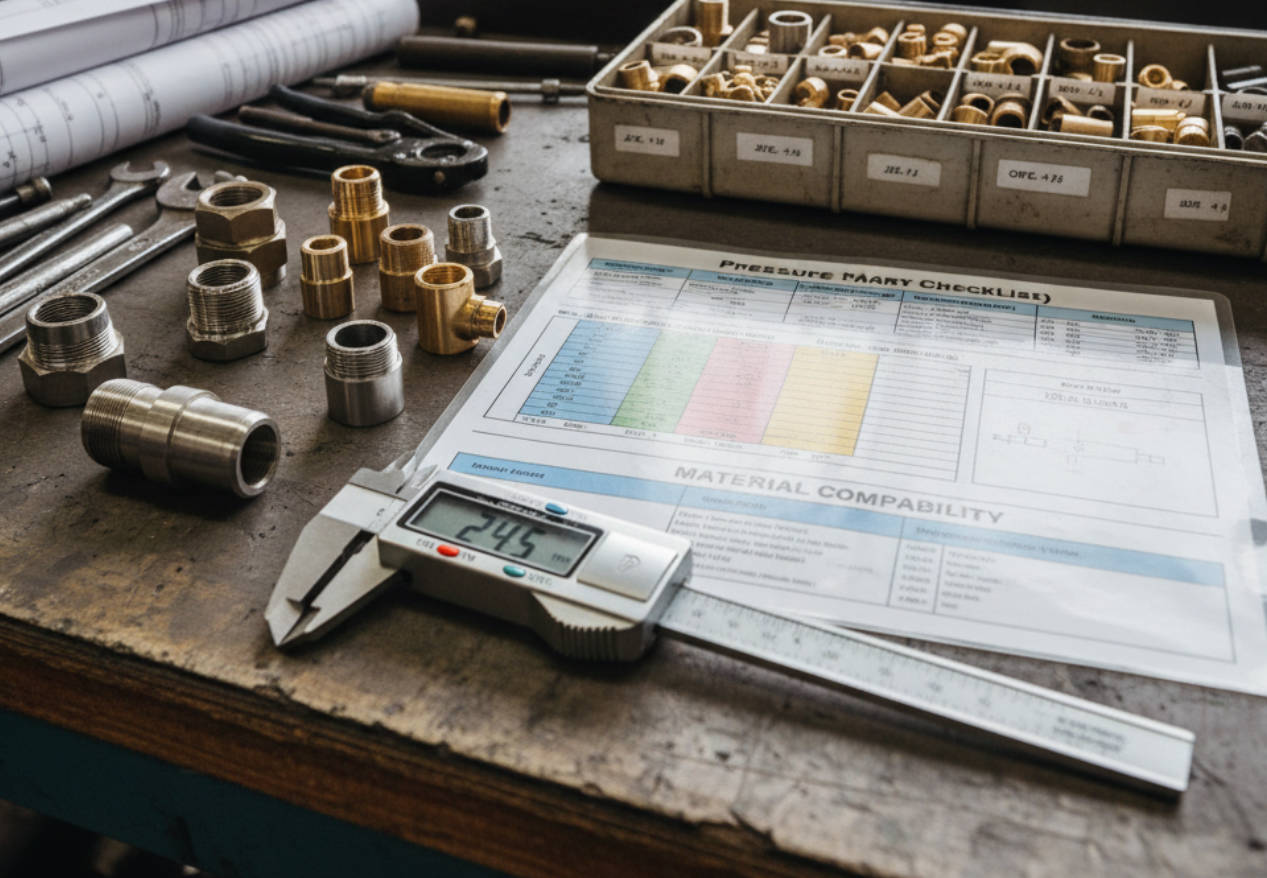
Hydraulic hose fittings connect hoses with pumps, valves, cylinders, motors, and other hydraulic components while maintaining a secure fluid path under pressure. Choosing the correct hydraulic fitting requires you to match thread type, sealing method, hose size, pressure rating, material, and fitting configuration rather than selecting a part by appearance alone.
Imagine that your maintenance team replaces a damaged fitting on an excavator. The thread appears correct, the connection tightens normally, and production resumes. Hours later, oil begins weeping around the joint because the thread matched while the sealing surface did not. For distributors, equipment manufacturers, and repair businesses, a structured selection process can prevent these costly mismatches before a fitting reaches the machine.
1. How Do You Choose the Right Hydraulic Fitting?
The right hydraulic fitting must match the hose, mating connection, operating pressure, sealing method, and installation layout. You should evaluate these specifications together because a fitting that satisfies only one requirement may still cause leakage or premature hose failure.
What specifications should you check?
Here’s where you should start. Record the actual operating requirements before comparing fitting part numbers.
- Thread standard and size
- Hose inside diameter
- Working pressure
- Seal or seat design
- Straight, 45°, or 90° configuration
- Material and surface treatment
Why does the sealing method matter?
This detail changes everything. Two fittings can have similar threads while using completely different sealing surfaces.
- Check for an O-ring.
- Inspect flare or cone surfaces.
- Determine whether threads create the seal.
- Match the mating component exactly.
Key Takeaway: Select fittings as part of a complete hydraulic connection, not as an isolated threaded component.
| Selection Point | What You Should Confirm |
|---|---|
| Thread | Standard, size, pitch |
| Hose | ID and hose series |
| Pressure | System working pressure |
| Seal | Matching sealing surface |
| Shape | Routing requirement |
Using these criteria together dramatically reduces specification errors.
Image Brief: Photorealistic industrial workbench showing several hydraulic hose fittings, hydraulic hose, digital calipers, thread gauges, and engineering drawings.
2. Which Hydraulic Fitting Types Are Commonly Used?
A hydraulic fitting may be straight, angled, swivel, compact, flange-style, or designed for specialized installation spaces. Choosing the right configuration lets you route hoses without excessive bending, twisting, or interference with surrounding equipment.
Which fitting shapes should you know?
The practical difference is simple. Each shape solves a particular routing or installation problem.
- Straight fittings support direct connections.
- 45° elbows change direction gradually.
- 90° elbows work in restricted layouts.
- Swivel fittings simplify assembly orientation.
- Banjo styles suit some low-clearance locations.
Does fitting shape affect hose life?
Yes, more than many buyers expect. Poor routing may create side loading or sharp hose bends near the connection.
- Avoid tight bend radii.
- Reduce twisting during installation.
- Keep hoses away from moving components.
- Allow adequate service access.
Key Takeaway: Choose fitting geometry around actual machine routing rather than simply ordering the easiest part to source.
| Fitting Style | Typical Purpose |
|---|---|
| Straight | Direct connection |
| 45° elbow | Moderate direction change |
| 90° elbow | Tight installation |
| Swivel | Easier orientation |
| Banjo | Restricted clearance |
Good routing reduces mechanical stress around hose ends.
Image Brief: Photorealistic lineup of straight, 45-degree, 90-degree, swivel, and banjo hydraulic hose fittings with clean industrial labeling.
3. Which Hydraulic Fitting Thread Types Should You Know?
A hydraulic fitting can use BSP, JIC, NPT, metric, SAE, ORFS, or other connection standards depending on equipment origin and application. Thread identification requires more than visual inspection because several standards can appear very similar.
How do BSP, JIC, and NPT differ?
This is where identification gets technical. Thread design and sealing geometry vary significantly among common systems.
- BSPP uses parallel threads.
- BSPT uses tapered threads.
- JIC commonly uses a 37° flare.
- NPT uses tapered pipe threads.
- Metric systems use metric thread pitches.
Why should you measure thread pitch?
A close visual match can fool you. Diameter may narrow the possibilities while pitch and sealing geometry provide stronger confirmation.
- Measure male outside diameter.
- Measure female connection dimensions.
- Use a thread pitch gauge.
- Check taper.
- Inspect the seat angle.
Key Takeaway: Confirm thread diameter, pitch, taper, and seal design before naming a fitting standard.
| Thread Family | Common Identification Feature |
|---|---|
| BSPP | Parallel thread |
| BSPT | Tapered BSP thread |
| JIC | 37° flare |
| NPT | Tapered pipe thread |
| Metric | Metric pitch |
Multiple identification points provide much stronger evidence than appearance alone.
Image Brief: Photorealistic technical comparison image showing BSP, JIC, NPT, and metric hydraulic fittings beside thread gauges.
4. How Do Hydraulic Fitting Adapters Differ From Hose Ends?
A hydraulic fitting attached directly to a hose performs a different role from an adapter, even though both components may contain similar threads. Hose ends terminate the hydraulic hose, while adapters connect different ports, thread standards, sizes, or orientations within the hydraulic circuit.
When should you use an adapter?
Here’s a common purchasing situation. Your equipment port may not match the hose-end connection available in your inventory.
- Convert one thread standard into another.
- Change connection size.
- Connect male and female interfaces.
- Modify connection orientation.
- Join existing components without replacement.
Can adapters simplify inventory?
For distributors, this can be useful. A structured adapter range may cover connection combinations without requiring numerous specialized hose-end assemblies.
- Standardize common hose ends.
- Stock frequently requested adapters.
- Record regional thread demand.
- Separate hose-end and adapter part numbers.
Key Takeaway: Use adapters for controlled connection changes rather than forcing incompatible fittings together.
| Component | Main Function |
|---|---|
| Hose fitting | Terminates hydraulic hose |
| Adapter | Converts connections |
| Reducer | Changes size |
| Elbow adapter | Changes direction |
Knowing this distinction makes purchasing and inventory management more efficient.
Image Brief: Photorealistic hydraulic hose end beside several hydraulic adapters, reducers, elbows, and conversion fittings on a warehouse inspection table.
5. How Do You Measure a Hydraulic Fitting Correctly?
A hydraulic fitting should be measured by checking thread diameter, pitch, seat geometry, fitting orientation, hose size, and overall dimensions. A caliper alone can provide useful dimensions, but complete identification normally requires several measurements.
Which tools should you prepare?
You don’t need complicated equipment. A small fitting-identification kit can solve many workshop questions.
- Vernier or digital calipers
- Thread pitch gauge
- Seat angle gauge
- Thread identification chart
- Clean fitting sample
What should you measure?
Now comes the useful part. Record every dimension before comparing the fitting against a catalog.
- Male thread outside diameter
- Female connection diameter
- Thread pitch or TPI
- Seat angle
- Hose inside diameter
- Overall fitting length
Key Takeaway: Build your identification from several measurements instead of trying to identify a fitting from one diameter.
| Measurement | Tool |
|---|---|
| Thread diameter | Caliper |
| Thread pitch | Pitch gauge |
| Seat angle | Angle gauge |
| Overall length | Caliper |
| Hose ID | Caliper |
A complete measurement record also helps suppliers quote replacements faster.
Image Brief: Photorealistic technician measuring a hydraulic fitting with digital calipers, pitch gauge, and seat-angle gauge.
6. Which Hydraulic Fitting Is Better: Crimped or Reusable?
A hydraulic fitting can use either a permanent crimped design or a reusable mechanical design, and neither option suits every application. Crimped fittings are widely used for production hose assemblies, while reusable fittings can help with selected field repairs or service situations.
How do crimped fittings work?
The principle is straightforward. A crimping machine compresses the ferrule around the hose and fitting stem according to a controlled specification.
- Requires suitable crimping equipment
- Uses predetermined crimp dimensions
- Provides repeatable production
- Common in professional hose assembly shops
When are reusable fittings useful?
There are situations where flexibility matters. Reusable fittings can be installed without a conventional production crimper when the fitting and hose are specifically designed for that assembly method.
- Field servicing
- Remote maintenance locations
- Selected older equipment
- Applications requiring easier replacement
Key Takeaway: Base your decision on hose compatibility, service requirements, assembly equipment, and manufacturer specifications.
| Feature | Crimped | Reusable |
|---|---|---|
| Installation | Crimping machine | Mechanical assembly |
| Connection | Permanent | Removable |
| Production use | Very common | More specialized |
| Field repair | Limited | Convenient in suitable systems |
Neither fitting style should be used without confirming hose compatibility.
Image Brief: Photorealistic split comparison showing a hydraulic crimping machine on one side and manual reusable fitting assembly on the other.
7. Can You Mix Different Hydraulic Fitting Brands?
A hydraulic fitting from one supplier should not automatically be treated as interchangeable with another supplier’s fitting just because nominal dimensions appear similar. Hose construction, stem geometry, ferrule dimensions, tolerances, and crimp specifications can differ.
What creates compatibility problems?
Small differences can become big problems under pressure. A hose-and-fitting assembly works through controlled mechanical engagement.
- Stem dimensions may differ.
- Ferrule wall thickness may vary.
- Crimp specifications may change.
- Hose reinforcement construction may differ.
- Manufacturing tolerances may not match.
What should B2B buyers request?
Documentation makes sourcing much easier. Give suppliers enough technical information to verify compatibility.
- Hose standard and series
- Hose ID and OD
- Fitting drawing
- Thread specification
- Pressure requirement
- Crimp specification
Key Takeaway: Do not approve mixed components based only on nominal part descriptions; verify dimensional and assembly compatibility.
| Compatibility Item | Buyer Check |
|---|---|
| Hose series | Confirm |
| Stem dimensions | Compare |
| Ferrule | Match |
| Crimp value | Verify |
| Pressure rating | Confirm |
This approach is especially useful when qualifying an alternative supplier.
Image Brief: Photorealistic quality-control inspection comparing two similar hydraulic hose fittings using precision measurement tools and engineering drawings.
8. What Happens When the Wrong Hydraulic Fitting Is Used?
The wrong hydraulic fitting can create leakage, damaged threads, poor sealing, hose stress, pressure loss, and potentially serious assembly failure. Incorrect connections are particularly risky when similar-looking thread standards are forced together or when the sealing faces do not match.
What warning signs should you watch for?
Your equipment often gives early clues. Small leaks or abnormal hose movement should not be ignored.
- Oil around connection points
- Damaged or distorted threads
- Hose twisting
- Loose fittings
- Corrosion
- Abnormal vibration
Why can a small mismatch become expensive?
This is where procurement affects operations. A low-cost fitting mistake may cause maintenance labor, replacement freight, fluid loss, and machine downtime.
- Production interruptions
- Repeat repair work
- Emergency purchasing
- Damaged mating components
- Customer complaints
Key Takeaway: Proper fitting identification protects more than the connection—it protects equipment uptime and maintenance budgets.
| Incorrect Selection | Possible Result |
|---|---|
| Wrong thread | Thread damage |
| Wrong seal | Leakage |
| Wrong pressure rating | Failure risk |
| Wrong angle | Hose stress |
| Wrong material | Corrosion |
Correct specification at the purchasing stage is far cheaper than repeated repairs.
Image Brief: Photorealistic close-up of a leaking hydraulic connection contrasted with a properly installed clean fitting.
9. How Often Should a Hydraulic Fitting Be Inspected?
A hydraulic fitting should be inspected as part of the machine’s planned maintenance program, with frequency adjusted for pressure, operating hours, environment, vibration, and application severity. High-duty equipment normally deserves closer monitoring than lightly used machinery.
What should an inspection include?
Look beyond obvious leaks. Early mechanical changes may appear before a connection fails.
- Surface corrosion
- Oil seepage
- Thread damage
- Hose abrasion
- Fitting movement
- Cracks or deformation
When should you replace a fitting?
Waiting for complete failure makes little sense. Replacement should be considered when damage affects sealing, structural integrity, or connection reliability.
- Severe corrosion
- Damaged sealing face
- Cracked fitting body
- Deformed threads
- Persistent leakage
- Damaged hose-to-fitting connection
Key Takeaway: Preventive inspection helps maintenance teams detect inexpensive problems before they become unplanned downtime.
| Inspection Area | Warning Sign |
|---|---|
| Seal area | Oil leakage |
| Body | Crack or deformation |
| Threads | Damage |
| Surface | Severe corrosion |
| Hose joint | Movement or abrasion |
Inspection records can also reveal recurring failure patterns.
Image Brief: Photorealistic maintenance engineer inspecting hydraulic hose fittings on construction equipment with flashlight and checklist.
10. How Should You Source a Hydraulic Fitting From a Supplier?
A hydraulic fitting should be sourced with a technical specification that clearly defines thread, hose size, pressure, material, sealing method, orientation, quantity, and any certification requirements. Detailed RFQs allow suppliers to identify the part faster and reduce unnecessary sample revisions.
What information should your RFQ contain?
Make your supplier’s job easier. A photograph alone rarely gives enough information for reliable production.
- Product drawing or sample
- Thread type and size
- Hose specification
- Material
- Surface treatment
- Working pressure
- Order quantity
- Packaging requirement
How can you qualify a new supplier?
Price should be only one comparison point. Evaluate whether the supplier can consistently reproduce your required product.
- Check dimensional inspection capability.
- Review sample quality.
- Confirm material specifications.
- Compare production lead times.
- Discuss customized parts.
- Evaluate technical response speed.
Key Takeaway: A strong RFQ turns a vague purchasing request into a measurable product specification.
| Supplier Check | Purchasing Purpose |
|---|---|
| Samples | Verify product fit |
| Drawings | Confirm dimensions |
| Inspection | Control consistency |
| Lead time | Plan inventory |
| OEM capability | Support custom demand |
Better technical communication generally produces faster quotations and fewer order disputes.
Image Brief: Photorealistic hydraulic fitting factory quality-control desk with fittings, inspection report, drawings, calipers, packaging samples, and computer. Include one clear technical infographic showing the B2B sourcing workflow.
Final Thoughts
Hydraulic hose fittings may look simple, but correct selection requires you to evaluate thread standards, sealing methods, hose dimensions, pressure, fitting geometry, materials, assembly methods, and actual operating conditions together.
This article addressed the questions that matter most during sourcing: which fitting styles exist, how thread systems differ, how fittings should be measured, when adapters are appropriate, whether components can be mixed, and what happens when specifications are wrong.
For distributors, repair businesses, equipment manufacturers, and hydraulic service companies, TOPA can support standard hose fittings, adapters, ferrules, hoses, and customized connection requirements. If you have a sample, drawing, specification sheet, or unidentified fitting, contact us today and provide the available dimensions for review.
Reliable hydraulic systems begin with connections that are correctly specified, consistently manufactured, and selected for the real working environment.
FAQ
Can I identify hydraulic hose fittings from a photo?
Yes, but a photo alone may not confirm the exact specification. Send clear images together with thread diameter, pitch, sealing surface, hose size, and any existing part markings whenever possible.
What’s the best way to measure a hydraulic fitting?
Use a caliper, thread-pitch gauge, and seat-angle gauge. Compare diameter, pitch, taper, and sealing geometry rather than relying on one measurement.
How do I know if hydraulic fittings are BSP or NPT?
Check thread taper, diameter, pitch, and thread form. Similar appearance does not confirm compatibility, so use a thread gauge or specification chart before assembly.
Can I use different brands of hose and fittings together?
Not automatically. Confirm hose construction, fitting stem dimensions, ferrule specification, crimp diameter, pressure rating, and applicable technical standards before approving mixed components.
What’s the best hydraulic fitting for high-pressure equipment?
The correct choice depends on system pressure, hose specification, connection standard, sealing method, operating temperature, fluid, vibration, and routing. Select the complete hose-and-fitting assembly according to documented application requirements.