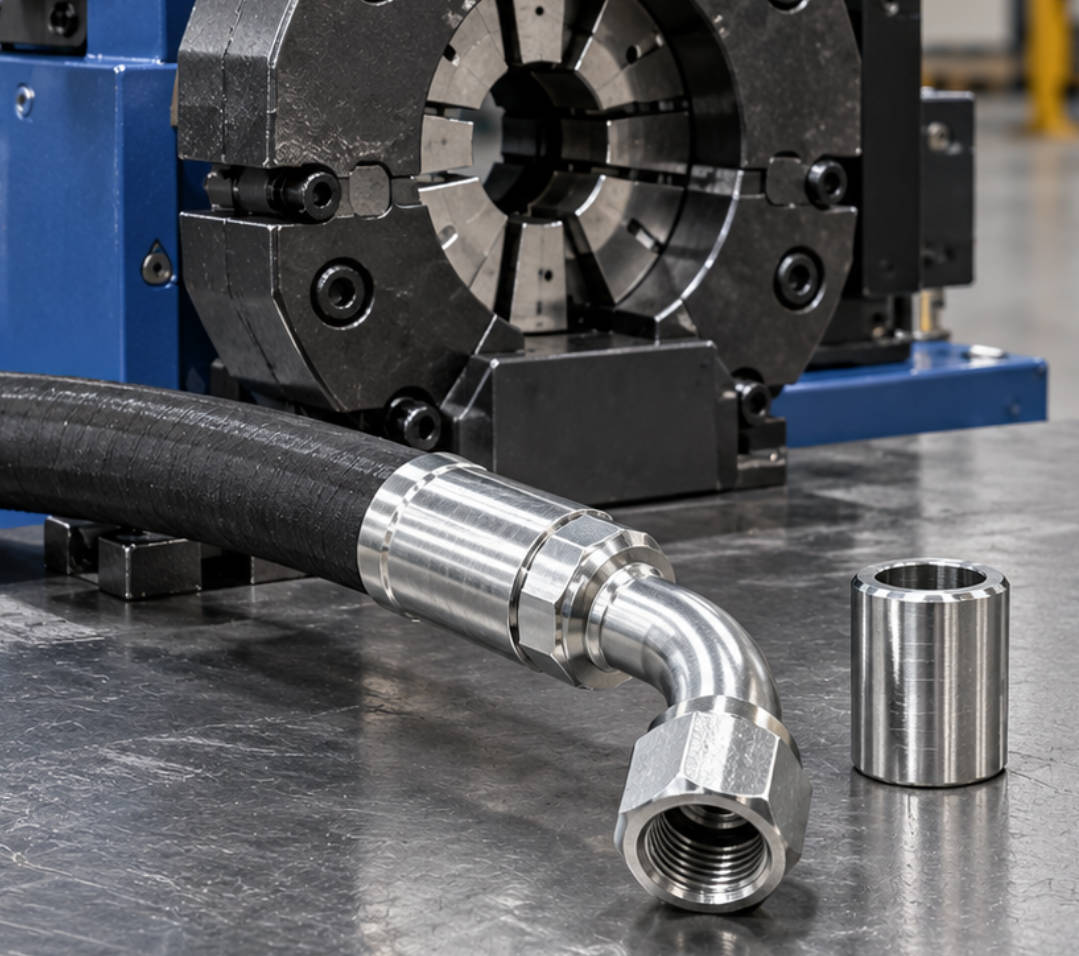
Hydraulic hose fittings are connectors that join hydraulic hoses with pumps, valves, cylinders, manifolds, and other fluid-power components while maintaining a secure fluid path under pressure. Choosing the correct hydraulic fitting requires you to consider material, pressure, temperature, connection style, sealing method, thread standard, and hose compatibility together.
Imagine that your maintenance team has two nearly identical fittings on the bench. Both threads appear correct, yet one relies on a 37-degree metal flare while the other seals with an O-ring. Picking the wrong one may result in leakage, damaged mating surfaces, repeat freight, or unexpected equipment downtime. Understanding how fittings are constructed and classified gives B2B buyers a more reliable way to specify and source the correct component.
1. What Does a Hydraulic Fitting Do in a Hydraulic System?
A hydraulic fitting securely joins a hose with another hydraulic component while maintaining fluid flow and controlling leakage. It may connect with pumps, actuators, filters, valves, manifolds, or another section of a hydraulic circuit.
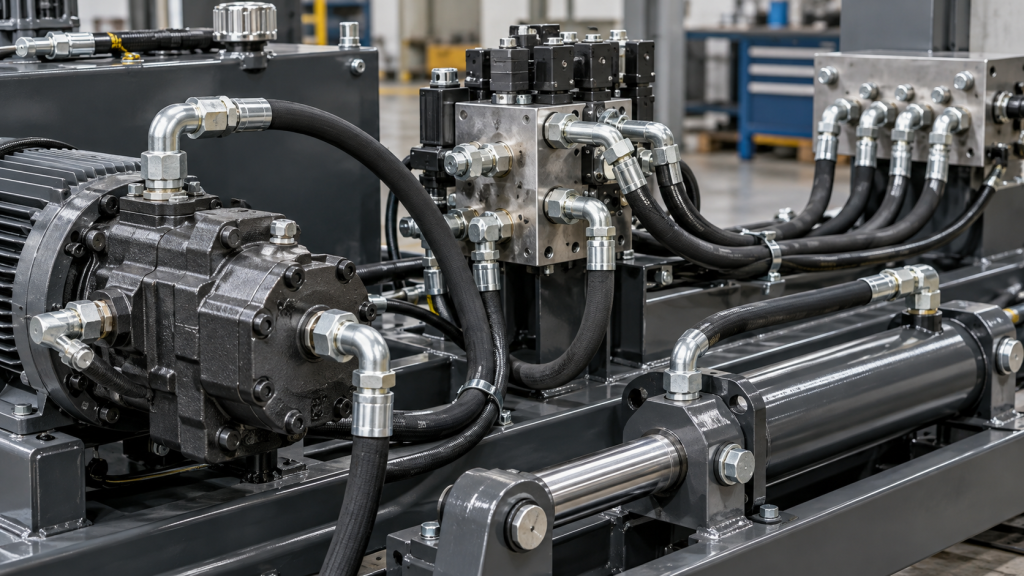
Where are hydraulic fittings commonly used?
Here’s where the connection matters. Hydraulic fittings appear anywhere flexible hose must connect with another fluid-power component.
- Construction machinery
- Agricultural equipment
- Manufacturing lines
- Hydraulic presses
- Mobile equipment
- Industrial automation
- Transportation equipment
Their small size can make them easy to overlook even though a failed connection may stop an entire hydraulic system.
Why does fitting selection affect system performance?
The answer goes beyond leakage. Incorrect connections can also cause pressure loss, damaged threads, hose stress, and repeated maintenance.
- Match the hose.
- Confirm the mating port.
- Check system pressure.
- Verify sealing design.
- Review operating temperature.
Key Takeaway: Treat every fitting as a functional part of the hydraulic circuit rather than a generic connector.
| Check | Buyer Should Confirm |
|---|---|
| Hose | Compatible size and construction |
| Port | Correct connection |
| Pressure | Suitable rating |
| Seal | Matching design |
| Temperature | Suitable operating range |
These basic checks give you a stronger starting point for every fitting purchase.
2. Which Hydraulic Fitting Material Fits Your Application?
A hydraulic fitting material should match pressure, temperature, corrosion exposure, fluid type, and environmental conditions. Carbon steel, stainless steel, brass, aluminum, and selected engineered materials offer different combinations of strength, corrosion resistance, weight, and cost.
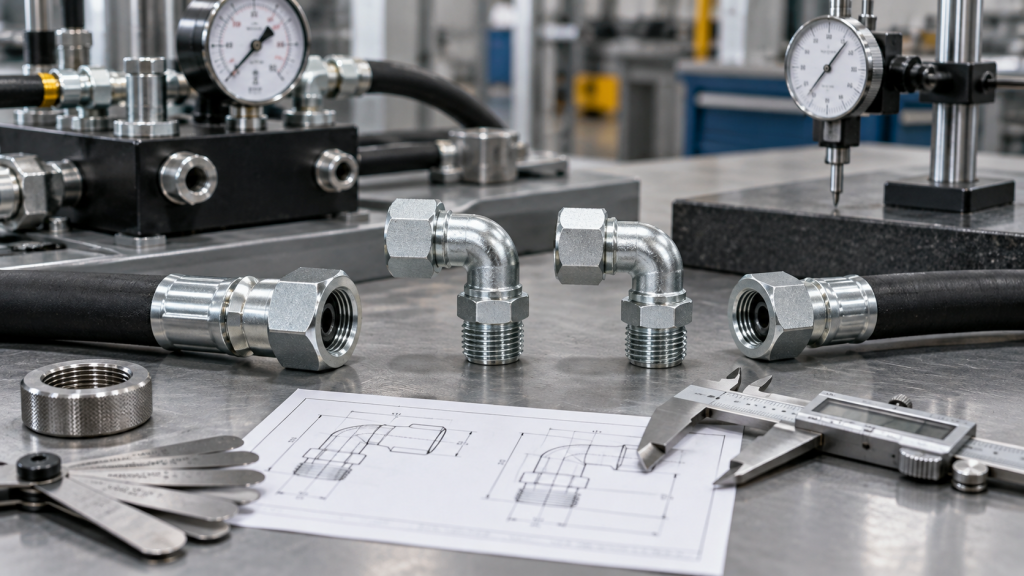
When should you use carbon steel or stainless steel?
For industrial buyers, these are common choices.
- Carbon steel offers strong mechanical performance.
- Plating can improve corrosion resistance.
- Stainless steel performs well in corrosive environments.
- Stainless steel suits many demanding outdoor applications.
- Both materials are available in many connection styles.
Carbon steel often provides a practical cost-performance balance, while stainless steel is attractive when corrosion resistance receives greater priority.
When do brass and aluminum make sense?
Application conditions decide the answer.
- Brass suits selected moderate-duty fluid systems.
- Aluminum reduces component weight.
- Aluminum can suit mobile or transportation applications.
- Material compatibility with fluid must still be checked.
- Pressure ratings vary with design and material grade.
Key Takeaway: Material should be selected from working conditions rather than price or appearance alone.
| Material | Main Purchasing Consideration |
|---|---|
| Carbon steel | Strength and value |
| Stainless steel | Corrosion resistance |
| Brass | Selected fluid applications |
| Aluminum | Low weight |
| Special materials | Specific environments |
Material specifications also make quotations from different suppliers easier to compare.
3. Should a Hydraulic Fitting Be Permanent or Reusable?
A hydraulic fitting can use a permanent crimped design or a reusable field-attachable design depending on the hose and service requirements. Crimped fittings suit controlled production, while reusable fittings provide more flexibility in selected maintenance situations.
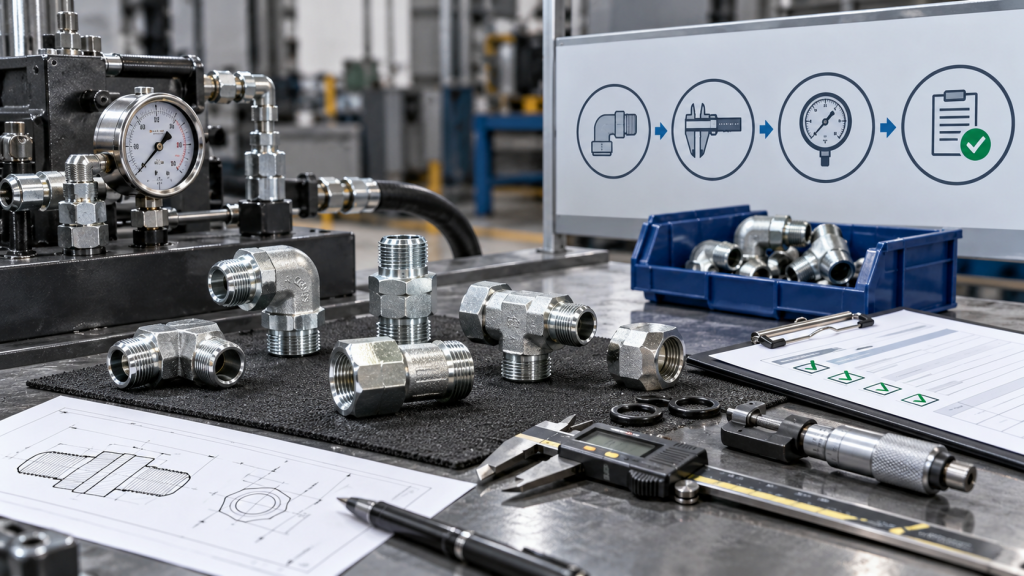
How do permanent fittings work?
The principle is controlled compression.
- Insert the fitting stem into the hose.
- Position the correct ferrule.
- Select suitable crimp dies.
- Apply the specified crimp diameter.
- Inspect the completed connection.
A hydraulic crimper is normally required, which makes this design common in hose shops and organized production environments.
When should you consider reusable fittings?
Field service changes the equation.
- Remote machine repairs
- Selected emergency replacements
- Compatible reusable hose systems
- Low-volume maintenance
- Applications without access to a crimper
Key Takeaway: Choose attachment style around hose compatibility, service requirements, and available assembly equipment.
| Feature | Crimped | Reusable |
|---|---|---|
| Installation | Crimper | Hand tools |
| Connection | Permanent | Serviceable |
| Production | Very suitable | Limited |
| Field repair | Less convenient | More flexible |
| Hose compatibility | Required | Required |
Neither fitting style should be treated as universal.
4. How Does a Hydraulic Fitting Create a Leak-Tight Seal?
A hydraulic fitting creates a seal through metal-to-metal contact, tapered thread engagement, an O-ring, gasket, or another designed sealing surface. The thread may provide mechanical attachment without being the actual sealing point.
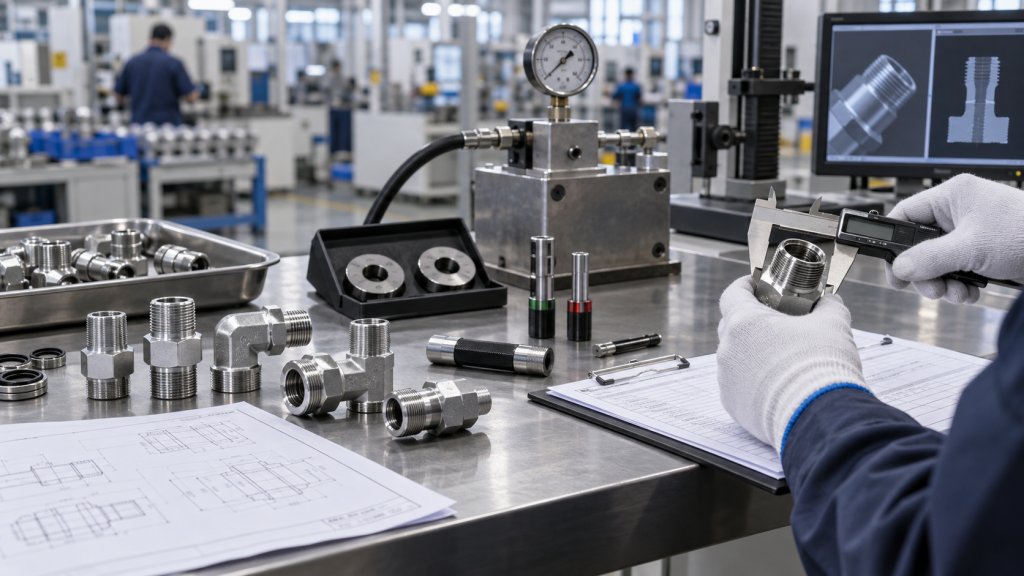
What are the main sealing methods?
This distinction prevents many identification errors.
- Metal-to-metal flare
- Metal cone connection
- Tapered thread
- O-ring face seal
- O-ring boss
- Gasket or soft seal
Different designs respond differently to pressure, vibration, contamination, and assembly technique.
Why should you identify the seal before the thread?
Because similar threads can hide different connections.
- Inspect the fitting face.
- Look for an O-ring.
- Check seat angle.
- Determine whether the thread is tapered.
- Compare the mating component.
Key Takeaway: Identify where fluid is actually sealed before approving any replacement fitting.
| Seal Style | Main Sealing Area |
|---|---|
| Metal flare | Angled mating surfaces |
| ORFS | Flat face and O-ring |
| ORB | O-ring near port |
| Tapered thread | Thread interface |
| Cone seal | Mating cone surfaces |
The sealing method often provides a faster clue than thread diameter alone.
5. How Does a JIC Hydraulic Fitting Work?
A hydraulic fitting using the JIC connection system typically relies on a 37-degree flared metal sealing surface. The threads provide mechanical engagement while the mating flare surfaces create the fluid seal.
How can you recognize a JIC connection?
Look beyond the straight thread.
- 37-degree flare
- Parallel mechanical threads
- Male and female mating surfaces
- Metal-to-metal sealing
- Multiple size options
A seat-angle gauge can help separate a JIC fitting from another connection with a similar-looking thread.
Why are JIC fittings common?
Their versatility makes them useful across many machines.
- Mobile hydraulics
- Construction equipment
- Agricultural machinery
- General industrial systems
- Repair and maintenance work
Key Takeaway: Confirm both the 37-degree seat and the thread specification before identifying a fitting as JIC.
| JIC Feature | Identification Point |
|---|---|
| Seat | 37° flare |
| Thread | Parallel |
| Seal | Metal-to-metal |
| Assembly | Male/female flare |
| Inspection | Thread plus seat |
This two-point verification reduces incorrect substitutions.
6. How Does an NPT Hydraulic Fitting Seal?
An NPT hydraulic fitting uses a tapered thread geometry that tightens progressively as male and female threads engage. The tapered thread itself plays a major role in creating the connection and sealing interface.
How can you identify NPT threads?
Measurement is safer than visual judgment.
- Check thread taper.
- Measure outside diameter.
- Determine threads per inch.
- Compare with an NPT chart.
- Inspect existing sealing practices.
Do not confuse NPT with another tapered thread simply because the connection begins to screw together.
Why can mismatched pipe threads cause problems?
A partial fit can be misleading.
- Different thread forms may engage briefly.
- Pitch may not match.
- Sealing may remain incomplete.
- Threads can become damaged.
- Future removal may become difficult.
Key Takeaway: Never confirm a tapered fitting from thread engagement alone.
| NPT Check | What to Confirm |
|---|---|
| Taper | Present |
| Diameter | Correct size |
| Pitch | Correct TPI |
| Thread form | NPT specification |
| Condition | No thread damage |
Accurate identification protects both the fitting and mating port.
7. When Should You Use an ORFS Hydraulic Fitting?
A hydraulic fitting using an O-Ring Face Seal creates its primary seal through an O-ring compressed between flat mating faces. This connection style can be useful where leakage control and vibration resistance receive close attention.
How do you identify an ORFS fitting?
The flat face gives you a strong clue.
- Flat sealing surface
- Visible O-ring on male face
- Straight mechanical thread
- Matching flat female surface
- Replaceable sealing element
Check O-ring condition whenever an ORFS connection is disassembled.
What should buyers check before ordering ORFS?
The connection still needs full verification.
- Thread size
- O-ring dimensions
- Material
- Pressure rating
- Fitting configuration
- Hose compatibility
Key Takeaway: ORFS identification should combine its flat face, O-ring location, and thread measurements.
| ORFS Feature | Buyer Check |
|---|---|
| Seal | Face O-ring |
| Surface | Flat |
| Thread | Straight |
| O-ring | Correct size/material |
| Hose end | Compatible fitting series |
A correct replacement must match the complete connection rather than the O-ring alone.
8. How Do You Select a Hydraulic Fitting for Real Applications?
A hydraulic fitting should be selected by comparing pressure, temperature, fluid, hose size, connection style, material, and operating environment. These application requirements help determine which fitting family and construction can perform reliably.
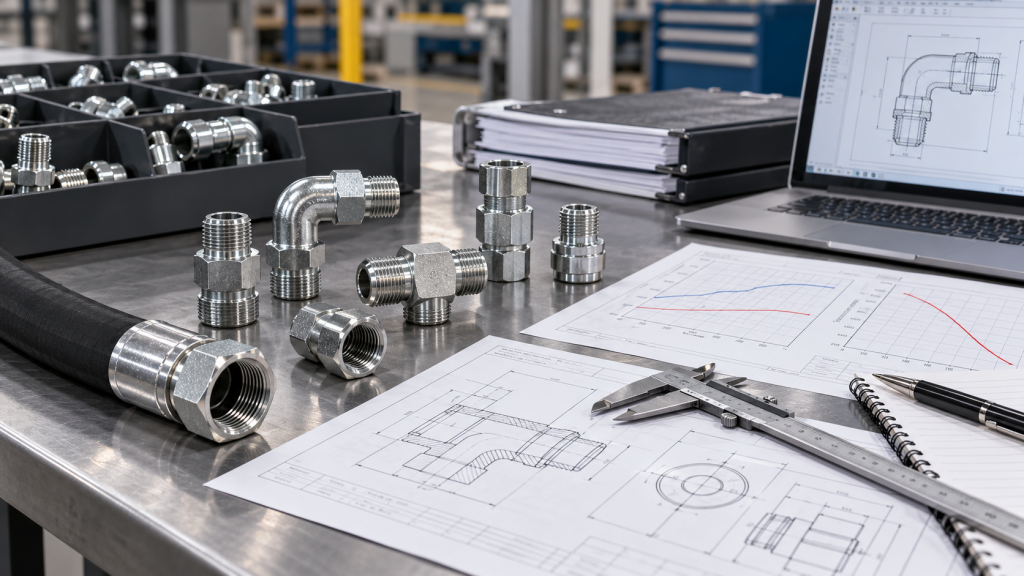
What information should you collect?
A good RFQ starts here.
- Working pressure
- Maximum temperature
- Hydraulic fluid
- Hose ID and OD
- Thread standard
- Fitting configuration
- Material requirement
- Environmental exposure
This information gives a supplier much more value than a photograph alone.
What should B2B buyers include in specifications?
Purchasing requirements matter too.
- Order quantity
- Surface treatment
- Drawings
- Samples
- Inspection requirements
- Packaging
- OEM marking
- Lead-time expectations
Key Takeaway: Good application data turns fitting selection into a measurable purchasing decision.
| Application Data | Why It Matters |
|---|---|
| Pressure | Defines service requirement |
| Temperature | Checks material and seals |
| Fluid | Confirms compatibility |
| Hose size | Determines fitting size |
| Environment | Influences material |
Detailed specifications reduce sample revisions and quotation delays.
9. How Do You Confirm Hydraulic Fitting Compatibility?
A hydraulic fitting is compatible only when dimensions, thread standard, sealing geometry, hose construction, material, and fluid requirements match the complete hydraulic system. Physical fit alone does not prove technical compatibility.

What compatibility points should you compare?
Small differences can matter under pressure.
- Thread diameter
- Thread pitch
- Seat angle
- Fitting stem
- Ferrule
- Hose construction
- Material
- Hydraulic fluid
Mixed components should be qualified before production use.
How should you approve alternative components?
Use measurements instead of assumptions.
- Inspect samples.
- Compare drawings.
- Measure dimensions.
- Assemble test hoses.
- Check crimp results.
- Perform required testing.
Key Takeaway: Alternative sourcing works best when compatibility is verified through specifications and sample approval.
| Compatibility Area | Verification |
|---|---|
| Thread | Gauge and measurement |
| Seal | Geometry inspection |
| Hose | Specification comparison |
| Material | Documentation |
| Crimp | Dimensional check |
This process gives buyers more sourcing flexibility without relying on guesswork.
10. Which Hydraulic Fitting Standards Should Buyers Check?
A hydraulic fitting should be checked against the applicable dimensional, pressure, connection, and compatibility standards required by the application or customer. ISO and SAE standards are commonly referenced in hydraulic systems, while specific products may also follow regional or equipment-specific requirements.
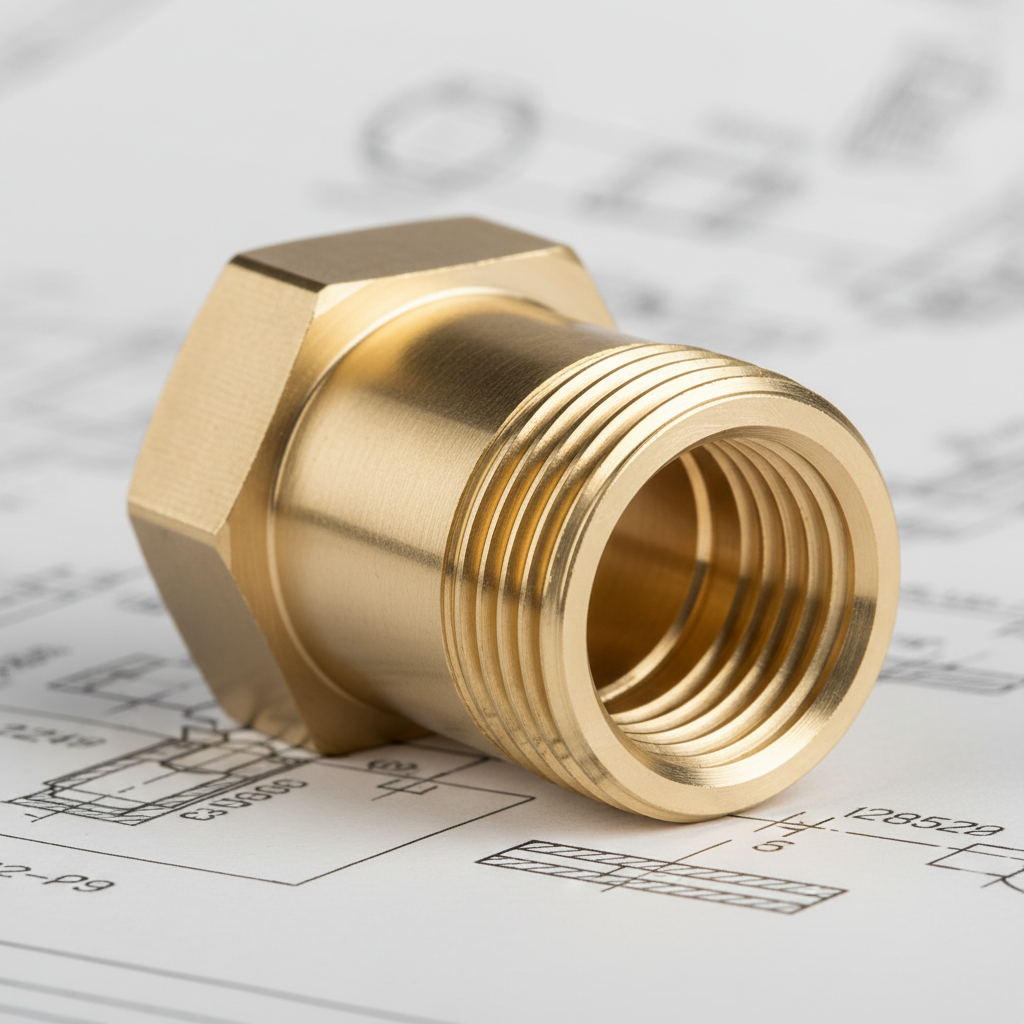
Why do standards matter during sourcing?
Standards create a shared technical language.
- Define dimensions.
- Clarify connection geometry.
- Support pressure requirements.
- Improve interchangeability.
- Help control inspection criteria.
They also make communication easier between manufacturers, distributors, and equipment companies in different countries.
What documentation should you request?
Make compliance measurable.
- Product drawings
- Material information
- Inspection reports
- Pressure data
- Thread specifications
- Applicable standard numbers
- Sample approval records
Key Takeaway: Standards help buyers compare fittings using defined specifications rather than supplier descriptions alone.
| Document | Purchasing Value |
|---|---|
| Drawing | Dimension control |
| Material record | Material verification |
| Inspection report | Quality evidence |
| Pressure data | Application check |
| Standard reference | Connection verification |
Clear documentation also simplifies future repeat orders.
Final Thoughts
Understanding hydraulic hose fittings requires more than knowing their thread size. Buyers need to consider fitting material, permanent or reusable construction, sealing method, JIC, NPT, ORFS and other connection types, pressure, temperature, fluid compatibility, hose compatibility, and applicable standards.
For hydraulic distributors, equipment manufacturers, maintenance businesses, and repair shops, this approach helps answer the practical questions that cause many sourcing errors: Which material should you order? Where does the connection seal? Can two similar fittings be substituted? Does the fitting match the hose? Which specifications should your supplier confirm?
TOPA supplies hydraulic fittings, adapters, ferrules, hydraulic hoses, and customized connection components for international B2B customers. If you have an existing fitting, drawing, thread measurement, hose specification, or new sourcing project, contact us today with your technical requirements.
Reliable hydraulic connections begin with correct identification, compatible components, measurable specifications, and consistent manufacturing.
FAQ
Can I identify a hydraulic fitting from its appearance?
No, appearance alone is rarely enough. Check thread diameter, pitch, taper, seat geometry, sealing method, and hose size before confirming the connection.
What’s the best hydraulic fitting material for industrial use?
Carbon steel suits many general hydraulic applications, while stainless steel may be better where corrosion resistance is a higher priority. The final choice depends on pressure, temperature, fluid, and environment.
How do I know if a hydraulic fitting is JIC or ORFS?
Check the sealing face. JIC normally uses a 37-degree metal flare, while ORFS uses a flat face with an O-ring.
Can I mix hydraulic fittings and hoses from different suppliers?
Yes, but only after technical compatibility has been confirmed. Compare stem dimensions, ferrule, hose construction, crimp data, pressure requirements, and sealing geometry.
What’s the best information to send a hydraulic fitting supplier?
Send clear photos, thread measurements, hose specifications, pressure and temperature requirements, material, quantity, drawings, and an existing sample when available.