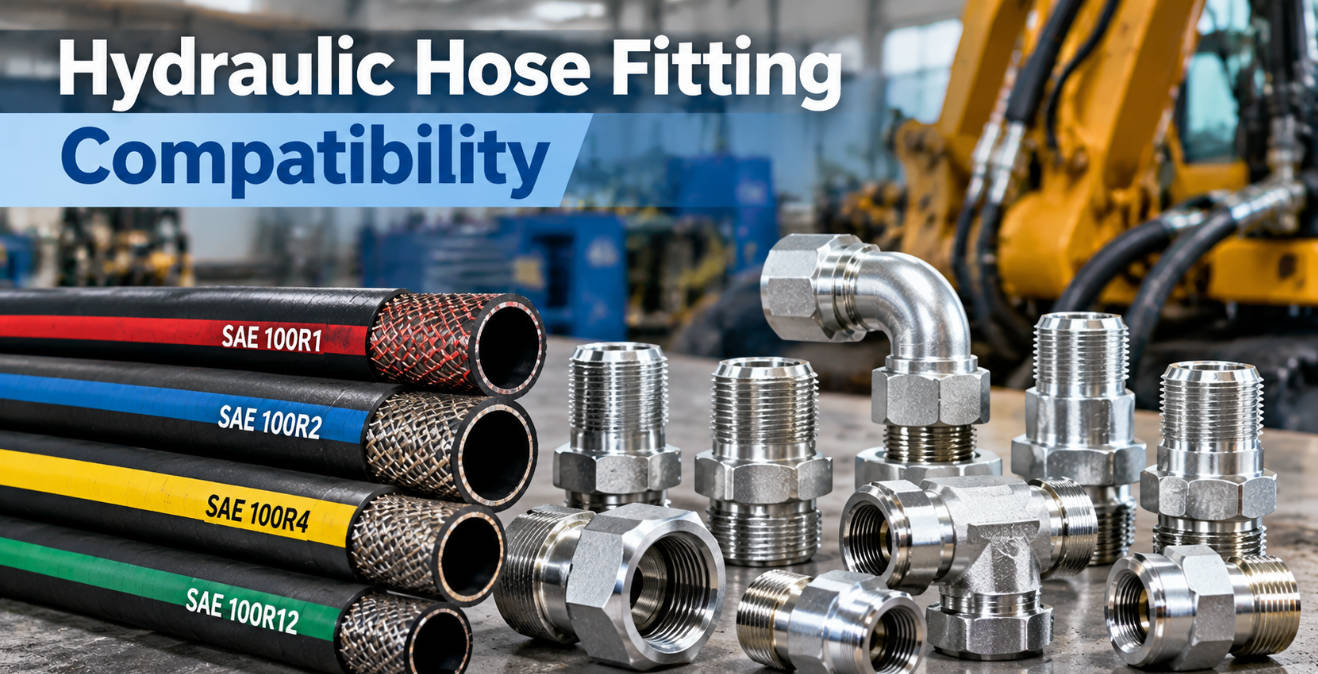
Hydraulic hose fittings should be used by matching the correct hose, fitting type, thread standard, material, pressure rating, temperature range, and assembly method before installation. A hydraulic fitting may look simple, but incorrect preparation or an incompatible connection can cause leakage, hose damage, repeated maintenance, or machine downtime.
Imagine that your workshop receives an urgent replacement request for an excavator hose. The hose size appears correct and the thread starts smoothly, yet the connection fails because the fitting was designed for another hose series or another sealing standard. A structured assembly process helps you avoid this problem and gives distributors, maintenance companies, and equipment manufacturers a repeatable way to handle hose fittings correctly.
1. How Should You Match a Hydraulic Fitting to the Hose?
A hydraulic fitting should match the hose size, construction, pressure rating, and compatible fitting series before assembly begins. Equal nominal hose sizes do not always mean that every stem, ferrule, and hose combination can work together safely.
What hose information should you check?
Start with the hose itself. Read the hose marking or technical data before selecting the fitting.
- Hose inside diameter
- Hose outside diameter
- Reinforcement type
- Working pressure
- Temperature range
- Hose series
- Fluid compatibility
You should record these details in your purchasing specification when the hose assembly will be reordered regularly.
Why does hose compatibility matter?
This is where many assembly mistakes begin. The fitting stem and ferrule must grip the hose construction correctly after crimping.
- Check stem diameter.
- Confirm ferrule type.
- Review insertion depth.
- Verify approved crimp data.
- Compare hose construction.
Key Takeaway: Treat the hose and fitting as one engineered assembly rather than two independent parts.
| Hose Check | Why It Matters |
|---|---|
| Hose ID | Matches fitting stem |
| Hose OD | Affects ferrule selection |
| Pressure | Defines application limit |
| Reinforcement | Influences attachment |
| Hose series | Supports compatibility |
Matching these factors first makes later assembly much more predictable.
2. How Do You Prepare a Hydraulic Fitting Before Assembly?
A hydraulic fitting should be inspected, cleaned, and matched with the correct hose before it enters the crimping process. Dirt, damaged threads, scratched sealing surfaces, or the wrong ferrule can compromise the connection before any pressure reaches the hose.
What should you inspect first?
A short inspection can save a complete rebuild. Look at both visible and hidden connection surfaces.
- Thread condition
- Sealing face
- Fitting stem
- Ferrule
- Internal passage
- Corrosion
- Deformation
Reject damaged fittings rather than trying to compensate during assembly.
Why should components remain clean?
Hydraulic contamination often starts during assembly. Metal chips, rubber particles, dust, and workshop debris can enter the hose before installation.
- Keep fittings capped.
- Clean the workbench.
- Protect hose ends.
- Remove cutting debris.
- Store components in clean containers.
Key Takeaway: Clean components help protect valves, pumps, cylinders, and other downstream components from avoidable contamination.
| Inspection Area | Acceptable Condition |
|---|---|
| Threads | No damage |
| Seal surface | Smooth |
| Stem | Correct dimensions |
| Ferrule | Correct part |
| Bore | Clean |
Preparation should be treated as part of quality control rather than an optional step.
3. How Should You Cut Hose for a Hydraulic Fitting?
A hydraulic fitting requires a hose end that has been cut squarely and cleanly at the correct finished length. Uneven cutting can affect fitting insertion, final assembly length, and ferrule position.
What makes a proper hose cut?
Accuracy matters before crimping begins.
- Measure required hose length.
- Mark the cut point.
- Use a hydraulic hose cutter.
- Make a square cut.
- Remove loose wire strands.
- Inspect the hose bore.
A clean cut gives the fitting a more consistent insertion surface.
Should you skive the hose?
That depends on the hose-and-fitting system. Some assemblies require removal of part of the hose cover, while no-skive systems are designed to avoid that preparation step.
- Follow hose specifications.
- Do not remove cover material unless required.
- Avoid damaging reinforcement.
- Check skive depth.
- Confirm fitting design.
Key Takeaway: Hose preparation must follow the requirements of the actual fitting system rather than workshop habit.
| Preparation Type | Main Requirement |
|---|---|
| No-skive | Clean square cut |
| External skive | Controlled cover removal |
| Internal skive | Follow specification |
| Length control | Accurate measurement |
Correct preparation reduces variation in the final hose assembly.
4. How Do You Insert a Hydraulic Fitting Into the Hose?
A hydraulic fitting should be inserted to the specified depth before crimping, with the stem correctly positioned inside the hose. Partial insertion can create insufficient retention while inconsistent insertion can change finished assembly dimensions.
How should you mark insertion depth?
Use a visible reference instead of guessing.
- Check fitting specification.
- Measure required depth.
- Mark the hose.
- Insert fitting to the mark.
- Confirm ferrule position.
This makes visual inspection easier before the assembly enters the crimper.
Should you lubricate the fitting?
Sometimes lubrication makes insertion easier. Use only a lubricant compatible with the hose, fitting, seal, and assembly instructions.
- Apply only when permitted.
- Avoid contamination.
- Do not use incompatible oils.
- Keep sealing surfaces clean.
- Confirm complete insertion.
Key Takeaway: Full and repeatable insertion gives the crimped connection a consistent starting position.
| Insertion Check | Desired Result |
|---|---|
| Depth mark | Visible reference |
| Fitting stem | Fully inserted |
| Ferrule | Correct position |
| Hose | No twisting |
| Lubrication | Compatible if used |
A correct insertion step reduces uncertainty during crimping.
5. How Should You Crimp a Hydraulic Fitting?
A hydraulic fitting should be crimped with the correct machine, dies, ferrule, and finished crimp diameter for the hose-and-fitting combination. Crimping is a controlled dimensional process rather than simply compressing the ferrule until it looks tight.
What should you set before crimping?
Machine setup determines the result.
- Fitting size
- Hose size
- Ferrule type
- Die set
- Crimp diameter
- Machine calibration
You should verify these values against the applicable crimp data before beginning production.
What should you inspect after crimping?
The job is not finished when the machine opens.
- Measure finished diameter.
- Check ferrule position.
- Inspect hose cover.
- Verify fitting alignment.
- Confirm insertion has not shifted.
Key Takeaway: Measuring the finished crimp gives you stronger quality evidence than visual inspection alone.
| Crimp Check | Purpose |
|---|---|
| Die selection | Correct compression |
| Crimp diameter | Dimensional control |
| Ferrule position | Attachment accuracy |
| Hose condition | Detect damage |
| Alignment | Confirm orientation |
Documented crimp values also make repeat production easier.
6. How Do You Identify the Correct Hydraulic Fitting Thread?
A hydraulic fitting thread should be identified through diameter, pitch, taper, sealing method, and seat geometry rather than appearance alone. Different thread standards can sometimes begin threading together even though the final connection is not compatible.
Which measurements should you take?
This is where guessing becomes risky.
- Male outside diameter
- Female connection diameter
- Thread pitch
- Threads per inch
- Taper
- Seat angle
Common systems can include BSP, NPT, JIC, metric, SAE, and other regional standards.
Why can similar threads cause problems?
A connection may engage without sealing correctly.
- Pitch may differ.
- Seat geometry may differ.
- Taper may differ.
- Thread form may differ.
- Engagement depth may be insufficient.
Key Takeaway: Confirm the thread and sealing method together before approving a replacement fitting.
| Identification Point | What It Confirms |
|---|---|
| Diameter | Approximate size |
| Pitch | Thread spacing |
| Taper | Thread family |
| Seat | Sealing style |
| Seal type | Connection design |
Combining these measurements reduces incorrect substitutions.
7. How Does Fitting Geometry Affect Hydraulic Hose Use?
A hydraulic fitting may be straight, angled, swivel, tee, cross, plug, or another configuration depending on system layout. The correct geometry helps route hoses without excessive bending, twisting, or interference with surrounding components.
Which fitting shapes are commonly used?
System layout drives this decision.
- Straight fittings
- 45° elbows
- 90° elbows
- Swivel fittings
- Tees
- Crosses
- Plugs
Different geometries allow designers to change flow direction or connect multiple circuits.
Why should you avoid unnecessary hose stress?
Poor routing shortens hose life.
- Respect minimum bend radius.
- Avoid hose twisting.
- Reduce side loading.
- Leave space for movement.
- Prevent rubbing against equipment.
Key Takeaway: Fitting geometry should help the hose follow a natural path through the machine.
| Geometry | Typical Purpose |
|---|---|
| Straight | Direct connection |
| 45° elbow | Moderate direction change |
| 90° elbow | Tight routing |
| Swivel | Easier orientation |
| Tee | Flow branch |
| Cross | Multiple branches |
Good geometry reduces installation stress and improves service access.
8. How Should You Select Hydraulic Fitting Material?
A hydraulic fitting material should match fluid type, temperature, corrosion exposure, pressure, and surrounding environment. Stainless steel, carbon steel, brass, and other materials offer different combinations of strength, corrosion resistance, and cost.
Which materials are commonly used?
Application conditions determine the best option.
- Carbon steel
- Stainless steel
- Brass
- Aluminum
- Specialized alloys
Carbon steel remains common in general hydraulic applications, while stainless steel may suit harsher environments.
What else should you specify?
Base material is only part of the specification.
- Plating
- Surface treatment
- Corrosion requirement
- Seal material
- Salt-spray requirement
- Fluid compatibility
Key Takeaway: Material selection should reflect the operating environment rather than appearance or unit price alone.
| Material | Typical Consideration |
|---|---|
| Carbon steel | Strength and cost |
| Stainless steel | Corrosion resistance |
| Brass | Selected fluid systems |
| Aluminum | Lightweight applications |
| Special alloy | Demanding environments |
Clear material specifications make supplier comparisons more meaningful.
9. How Do Pressure and Temperature Affect Hydraulic Fitting Use?
A hydraulic fitting should operate within the pressure and temperature limits of the complete hose assembly. A fitting may physically connect correctly yet remain unsuitable if its working limits do not match the hydraulic system.
What pressure information should you record?
Normal pressure is only one data point.
- Working pressure
- Maximum pressure
- Pressure spikes
- Duty cycle
- Test requirements
The lowest-rated component can determine the practical limit of the assembly.
Why does temperature matter?
Heat affects more than the metal fitting.
- Hose inner tube
- Hose cover
- O-rings
- Seals
- Hydraulic fluid
- Surface coating
Key Takeaway: Evaluate pressure and temperature across the complete hose assembly rather than checking the fitting body alone.
| Operating Factor | Component to Check |
|---|---|
| Working pressure | Hose and fitting |
| Pressure spike | Complete assembly |
| Fluid temperature | Hose and seal |
| Ambient heat | Hose cover |
| Extreme cold | Elastomer performance |
These limits should appear in technical purchasing documents.
10. How Should Buyers Verify Hydraulic Fittings Before Ordering?
A hydraulic fitting should be verified by checking hose compatibility, dimensions, thread standard, sealing method, material, pressure, temperature, and assembly requirements before a bulk order is placed. Clear technical information also makes supplier quotations faster and easier to compare.
What should you send your supplier?
Provide measurable information rather than only a photo.
- Hose specification
- Thread size
- Thread pitch
- Seat angle
- Material
- Pressure
- Temperature
- Quantity
- Drawing or sample
Clear information reduces unnecessary sample revisions.
How should you approve a new fitting?
Use a repeatable qualification process.
- Inspect dimensions.
- Compare threads.
- Check sealing surfaces.
- Verify material.
- Assemble sample hoses.
- Measure crimp results.
- Test if required.
Key Takeaway: A documented approval process reduces sourcing risk and gives both buyer and supplier the same technical reference.
| Approval Item | What to Verify |
|---|---|
| Dimensions | Drawing compliance |
| Thread | Correct standard |
| Material | Required grade |
| Crimp | Correct diameter |
| Assembly | Hose compatibility |
| Sample | Fit and function |
A controlled sourcing process makes repeat orders much easier to manage.
Final Thoughts
Using hydraulic hose fittings correctly requires more than pushing a fitting into a hose and crimping it. You need to match the hose and fitting, prepare the hose correctly, control insertion depth, follow crimp specifications, identify threads accurately, select suitable geometry and materials, and verify pressure and temperature limits.
For distributors, equipment manufacturers, hydraulic repair shops, and maintenance companies, these steps solve practical problems before they become expensive ones. They help reduce leaks, incorrect fittings, repeated freight, assembly failures, and avoidable equipment downtime.
TOPA supplies hydraulic hose fittings, adapters, ferrules, hydraulic hoses, and customized hydraulic connection components for international B2B customers. If you have an existing sample, drawing, thread measurement, hose specification, or assembly requirement, contact us today with your technical information.
Reliable hydraulic assemblies begin with correct matching, controlled installation, and components selected for the actual working conditions.
FAQ
Can I use hydraulic hose fittings from different suppliers?
Yes, but only after compatibility has been technically verified. Check hose construction, stem dimensions, ferrule design, crimp diameter, sealing geometry, and pressure requirements before approving mixed components.
What’s the best way to identify a hydraulic hose fitting?
Use thread diameter, pitch, taper, seat angle, sealing method, and hose size together. A photograph helps, but measurements give a much stronger identification result.
How do I know if a hydraulic fitting is crimped correctly?
Measure the finished crimp diameter and compare it with the applicable specification. Also inspect fitting insertion, ferrule position, hose condition, and alignment.
Can I use a fitting if the thread screws into the port?
No. Thread engagement alone does not prove compatibility. The pitch, taper, sealing surface, and connection standard must also match.
What’s the best information to send a hydraulic fitting supplier?
Send the hose specification, thread measurements, fitting photos, material requirements, working pressure, temperature, quantity, and a drawing or physical sample when available.