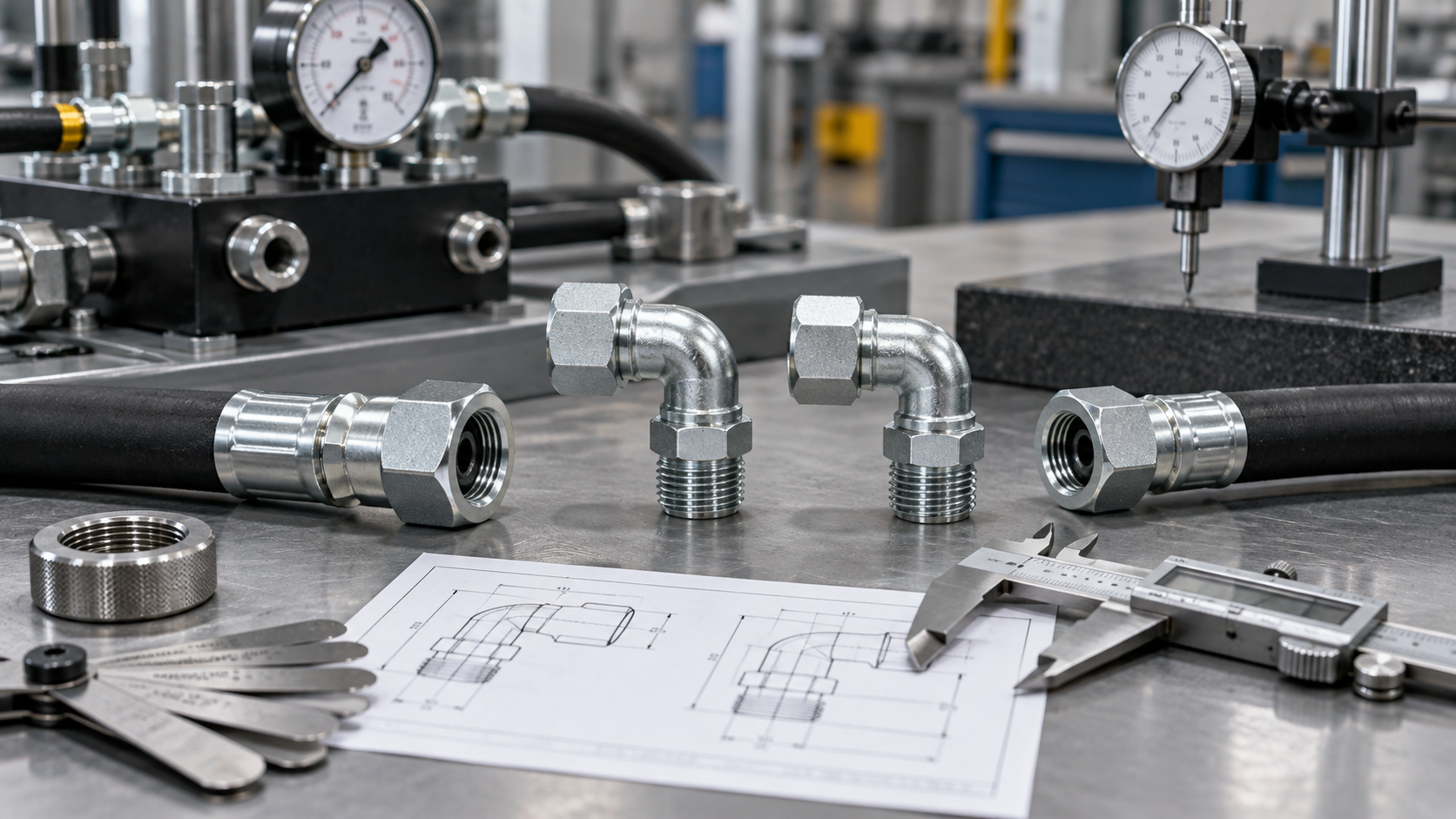
Hydraulic hose fittings connect hoses with pumps, valves, cylinders, motors, manifolds, and other hydraulic components while keeping pressurized fluid contained. Choosing the correct hydraulic fitting means looking beyond thread size and checking hose compatibility, sealing method, pressure, temperature, material, fitting standard, and assembly method.
Imagine that you manage replacement parts for excavators, agricultural machines, or industrial equipment. Two fittings on your shelf may look almost identical, yet one uses a 37-degree flare while another seals through an O-ring, and choosing the wrong one can mean leakage, damaged ports, repeat freight, or machine downtime. This guide gives you a practical framework for identifying, selecting, installing, and maintaining hydraulic hose fittings before those problems reach your customer.
1. What Is a Hydraulic Fitting and What Does It Do?
A hydraulic fitting connects components inside a hydraulic circuit while maintaining a secure path for pressurized fluid. Its main job goes beyond physically joining two parts because the connection must also control leakage, resist operating loads, and remain compatible with the hose or port.
Image Brief: Photorealistic hydraulic system showing hoses, fittings, pump, valve block, and cylinder with major connection points clearly visible.
Where are hydraulic fittings used?
Here’s the practical view. You will find hose fittings anywhere flexible hydraulic lines connect with equipment.
- Hydraulic pumps
- Control valves
- Cylinders
- Hydraulic motors
- Manifolds
- Construction machinery
- Agricultural equipment
- Industrial production lines
For a distributor or maintenance company, understanding where the fitting will operate makes identification much easier.
What makes a fitting suitable for hydraulic service?
Pressure changes the requirements. A suitable connection must match more than physical dimensions.
- Correct thread standard
- Compatible sealing surface
- Suitable fitting material
- Matching hose size
- Appropriate operating pressure
- Suitable temperature range
Key Takeaway: Treat a fitting as part of the complete hydraulic system rather than a simple threaded connector.
| Fitting Requirement | Why It Matters |
|---|---|
| Thread compatibility | Allows correct connection |
| Seal design | Controls leakage |
| Hose compatibility | Supports retention |
| Material | Matches environment |
| Pressure rating | Supports application |
A correctly specified fitting gives every later assembly step a better starting point.
2. Should You Use Crimped or Reusable Hydraulic Fittings?
A hydraulic fitting can use a permanent crimped connection or a field-attachable design, depending on hose construction and service requirements. Crimped fittings dominate many professional hose assemblies because controlled crimp dimensions provide repeatable attachment.
Image Brief: Photorealistic split scene comparing a professionally crimped hydraulic hose fitting with a field-attachable reusable fitting.
How does a crimped fitting work?
The process is controlled rather than improvised. A compatible stem and ferrule are installed on the hose before a crimping machine compresses the assembly according to specified dimensions.
- Select the correct fitting.
- Match the ferrule.
- Insert the fitting fully.
- Select the proper crimp dies.
- Apply the specified crimp diameter.
- Inspect the finished assembly.
Portable and workshop crimpers can serve different production or maintenance environments.
When can a reusable fitting make sense?
Field conditions can change your decision. Reusable fittings may suit compatible systems where assembly equipment is unavailable or field servicing is required.
- Remote maintenance work
- Emergency repair situations
- Selected older equipment
- Compatible reusable hose systems
- Low-volume service applications
Key Takeaway: Choose attachment style according to hose compatibility and operating conditions rather than installation convenience alone.
| Feature | Crimped Fitting | Reusable Fitting |
|---|---|---|
| Installation | Crimping equipment | Mechanical assembly |
| Connection | Permanent | Serviceable |
| Production use | Common | More specialized |
| Field work | Portable crimper possible | Convenient |
| Compatibility check | Required | Required |
The hose and fitting must remain an approved or technically verified combination in either case.
3. Which Hydraulic Fitting Materials Are Common?
A hydraulic fitting is commonly manufactured from carbon steel, stainless steel, or brass, with material choice depending on pressure, corrosion, fluid, temperature, and cost requirements. No single material provides the right balance for every application.
Image Brief: Photorealistic carbon-steel, stainless-steel, and brass hydraulic fittings positioned side by side on a quality-control workbench.
When is carbon steel suitable?
For many industrial buyers, carbon steel is the standard starting point. It combines mechanical strength, broad availability, and competitive cost.
- Construction equipment
- Agricultural machinery
- General industrial systems
- Hydraulic repair shops
- Mobile machinery
Different plating and surface treatments can provide added corrosion protection.
When should you consider stainless steel or brass?
Environment becomes the deciding factor. Stainless steel becomes attractive where corrosion resistance has higher priority, while brass suits selected applications with different pressure and media requirements.
- Stainless steel for corrosive environments
- Stainless steel for selected chemical systems
- Brass for compatible fluid applications
- Brass for selected lower-pressure systems
- Special alloys for unusual operating conditions
Key Takeaway: Specify material from application data instead of choosing solely on purchase price.
| Material | Main Buying Consideration |
|---|---|
| Carbon steel | Strength and cost |
| Stainless steel | Corrosion resistance |
| Brass | Fluid compatibility |
| Special alloy | Specialized environments |
A clear material specification also makes supplier quotations easier to compare.
4. Which Hydraulic Fitting Standards Should Buyers Recognize?
A hydraulic fitting may follow American, British, ISO metric, German, Japanese, or other regional standards, so buyers should identify both thread and sealing geometry before approving a replacement. Equipment origin often provides useful clues, but measurement remains necessary.
Image Brief: Photorealistic technical display of JIC, ORFS, BSP, metric DIN, NPT, and JIS hydraulic fittings beside thread gauges.
Which American fitting standards are common?
Several families appear frequently in international sourcing. Buyers commonly encounter the following connection styles:
- NPT
- NPTF
- NPSM
- SAE ORB
- JIC 37-degree flare
- ORFS
JIC uses an angled metal sealing surface, while ORFS relies on a flat face and O-ring.
Which international standards may appear?
Imported machinery expands the possibilities. Equipment from Europe and Asia can use several additional systems.
- BSPP
- BSPT
- ISO metric
- DIN metric connections
- JIS connections
- Four-bolt flange connections
Key Takeaway: Never identify a fitting standard from outside diameter alone; compare thread pitch and sealing geometry as well.
| Family | Common Identification Clue |
|---|---|
| JIC | 37° flare |
| ORFS | Flat face with O-ring |
| BSPP | Parallel BSP thread |
| BSPT | Tapered BSP thread |
| Metric | Metric pitch |
| NPT | Tapered pipe thread |
Combining several identification points greatly reduces incorrect substitutions.
5. How Do Hydraulic Fitting Connections Create a Seal?
A hydraulic fitting generally seals through an O-ring face, mating angled surfaces, another elastomeric seal, or a tapered thread design. Understanding where the seal occurs prevents buyers from assuming that thread engagement alone proves compatibility.
Image Brief: Photorealistic technical cutaway showing O-ring face seal, 37-degree flare connection, and tapered thread sealing methods.
How does an O-ring connection seal?
Look at the sealing face, not only the threads. In an O-ring face connection, a compressed elastomer provides the fluid barrier.
- Flat mating surfaces
- O-ring seal
- Straight mechanical threads
- Defined compression area
- Replaceable sealing element
Such designs can be useful where vibration and leakage control receive close attention.
How do angled and tapered connections differ?
The sealing principle changes completely. Mated-angle fittings use matching metal surfaces, while tapered threads rely on progressive thread engagement.
- JIC commonly uses a 37° flare.
- Other connections may use different cone angles.
- Tapered threads tighten progressively.
- Pipe-thread systems require correct identification.
- Sealing surfaces should remain undamaged.
Key Takeaway: Find the actual sealing surface before deciding whether two fittings can work together.
| Connection Style | Main Seal Location |
|---|---|
| ORFS | O-ring on flat face |
| JIC | Angled metal surfaces |
| ORB | O-ring near port |
| Tapered thread | Thread interface |
| Cone connection | Mating cone surfaces |
Seal identification often provides a faster answer than thread appearance alone.
6. How Should You Select a Hydraulic Fitting for an Application?
A hydraulic fitting should be selected by reviewing size, temperature, application, assembly method, material, pressure, and fluid compatibility as one group of requirements. Buyers who focus only on thread size risk missing conditions that directly affect service life.
Image Brief: Photorealistic purchasing engineer reviewing hydraulic fitting drawings, hose samples, pressure data, and application specifications.
What application information should you collect?
This is where a good RFQ begins. Give your supplier enough data to understand the working environment.
- Thread size
- Hose ID and OD
- Operating temperature
- Working pressure
- Pressure surges
- Hydraulic fluid
- Equipment type
- Vibration conditions
This information also helps suppliers recommend suitable materials and sealing systems.
What should B2B buyers add to the RFQ?
Technical data reduces quotation mistakes. Include production and commercial requirements alongside application information.
- Required quantity
- Material
- Surface treatment
- Drawing or sample
- Packaging requirements
- Inspection requirements
- OEM marking needs
Key Takeaway: A detailed RFQ turns fitting selection from guesswork into a measurable sourcing process.
| RFQ Item | Purpose |
|---|---|
| Thread specification | Confirms connection |
| Hose size | Confirms fitting series |
| Pressure | Defines service requirement |
| Fluid | Confirms compatibility |
| Quantity | Supports quotation |
| Drawing | Controls dimensions |
Clear requirements shorten communication and reduce sample revisions.
7. How Do You Install a Hydraulic Fitting Correctly?
A hydraulic fitting should be installed using the correct hose, fitting, ferrule, preparation method, crimp specification, and final inspection procedure. Even a correctly selected fitting can fail if assembly quality is inconsistent.
Image Brief: Photorealistic hydraulic hose production station with cutting machine, fitting insertion process, and hydraulic crimper.
How should you prepare the hose?
Good attachment starts before crimping. Prepare the hose carefully before installing any components.
- Measure required length.
- Cut the hose squarely.
- Remove cutting debris.
- Inspect reinforcement.
- Clean the internal passage.
- Mark insertion depth where required.
Keeping contaminants out during preparation also protects downstream hydraulic components.
How should you crimp and inspect the fitting?
Machine setup matters. Use specified dies and crimp dimensions for the chosen hose-and-fitting combination.
- Insert the fitting completely.
- Confirm ferrule position.
- Select correct dies.
- Apply specified crimp settings.
- Measure finished diameter.
- Inspect fitting orientation.
Key Takeaway: Crimping is a controlled manufacturing operation, not simply squeezing a ferrule until it looks secure.
| Assembly Check | What to Verify |
|---|---|
| Hose cut | Square and clean |
| Insertion | Correct depth |
| Ferrule | Correct part |
| Crimp | Specified diameter |
| Orientation | Matches assembly |
| Cleanliness | Bore remains clean |
Documenting these checks helps reproduce the same assembly on repeat orders.
8. How Do You Inspect a Hydraulic Fitting After Assembly?
A hydraulic fitting should be visually and dimensionally inspected after assembly before the hose enters service. Inspection gives operators an opportunity to catch incorrect crimp dimensions, orientation problems, damage, or contamination before pressure exposes the mistake.
Image Brief: Photorealistic hydraulic hose quality inspector measuring a finished crimp with digital calipers beside an inspection sheet.
What should visual inspection cover?
Start with what you can see immediately.
- Ferrule position
- Hose cover condition
- Fitting alignment
- Thread condition
- Surface damage
- Contamination
- Assembly length
Any abnormal deformation deserves further investigation.
When should pressure testing be considered?
Some applications demand another verification layer. Testing requirements should follow the customer’s specification and applicable safety procedures.
- Confirm test procedure.
- Use appropriate protective equipment.
- Secure the assembly.
- Check for leakage.
- Record results where required.
- Depressurize safely after testing.
Key Takeaway: Final inspection separates production from assumption and gives buyers measurable evidence of assembly quality.
| Inspection Stage | Example Check |
|---|---|
| Visual | Damage or misalignment |
| Dimensional | Crimp diameter |
| Cleanliness | Internal contamination |
| Pressure test | Leakage |
| Documentation | Traceable result |
Inspection records can also support quality discussions with OEM and distributor customers.
9. How Should Hydraulic Fittings Be Maintained?
A hydraulic fitting should be included in routine hose-system inspections because vibration, corrosion, abrasion, heat, contamination, and pressure cycling can change connection condition over time. Maintenance should focus on both the fitting and the hose surrounding it.
Image Brief: Photorealistic maintenance technician inspecting hydraulic hoses and fittings on construction equipment with flashlight and maintenance checklist.
What warning signs should you look for?
Small changes can warn you before failure.
- Oil seepage
- Loose connections
- Corrosion
- Surface cracks
- Hose abrasion
- Bulging hose
- Damaged threads
- Unusual hose movement
Do not inspect only the visible metal body; also examine the area where the hose enters the fitting.
Should damaged fittings be reused?
Condition matters more than appearance. Permanently crimped hose ends should be treated as part of the finished assembly, while serviceable connection components require inspection before reuse.
- Inspect threads.
- Examine sealing faces.
- Replace damaged seals.
- Reject cracked components.
- Check deformation.
- Follow the component specification.
Key Takeaway: Preventive inspection costs far less than unplanned hydraulic failure and emergency replacement.
| Warning Sign | Recommended Response |
|---|---|
| Leakage | Identify source |
| Corrosion | Evaluate replacement |
| Damaged seal | Replace seal/component |
| Cracked body | Replace fitting |
| Hose damage | Replace assembly |
Maintenance history can also reveal recurring problems with routing or component selection.
10. How Can Buyers Source Hydraulic Hose Fittings More Reliably?
A hydraulic fitting should be sourced from a supplier that can match drawings, thread standards, materials, hose requirements, inspection criteria, and delivery needs consistently. For B2B buyers, stable quality and technical response can matter as much as unit price.
Image Brief: Photorealistic hydraulic fitting factory inspection area with fittings, calipers, thread gauges, engineering drawings, packaging, and quality records. Include a clear B2B sourcing workflow chart.
What should you evaluate before placing a bulk order?
Samples provide a useful first checkpoint. Compare measurable characteristics before moving from trial quantity to production.
- Dimensional accuracy
- Thread quality
- Sealing surface
- Material specification
- Surface treatment
- Hose compatibility
- Packaging quality
- Marking requirements
A sample should represent the specification you expect in repeat production.
What makes a supplier practical for long-term sourcing?
Price is only one part of the relationship. Buyers also need consistent communication and predictable production.
- Fast technical response
- Stable quality control
- Reasonable lead times
- OEM capability
- Product range
- Inventory support
- After-sales service
Key Takeaway: The best sourcing process combines correct specifications, sample verification, consistent inspection, and responsive supplier support.
| Supplier Factor | B2B Value |
|---|---|
| Technical support | Faster identification |
| Product range | Fewer suppliers |
| Quality control | Batch consistency |
| OEM service | Custom requirements |
| Inventory | Faster replenishment |
| After-sales support | Easier problem solving |
A reliable sourcing system reduces both purchasing workload and the hidden cost of incorrect components.
Final Thoughts
Understanding hydraulic hose fittings requires more than memorizing thread names. Buyers need to understand fitting construction, materials, international standards, sealing methods, application requirements, hose compatibility, installation procedures, inspection points, and maintenance practices.
For distributors, equipment manufacturers, maintenance workshops, and hydraulic service businesses, this framework helps solve a practical sourcing problem: converting an unfamiliar fitting or application requirement into specifications that can be measured, quoted, tested, reordered, and managed consistently.
TOPA supplies hydraulic fittings, adapters, ferrules, hoses, and customized hydraulic connection components for international B2B customers. If you need help matching a fitting from a drawing, existing sample, thread measurement, or hose specification, contact us today with your technical requirements.
Reliable hydraulic connections start with accurate identification, compatible components, controlled production, and a supplier that understands how the product will perform in the real application.
FAQ
Can I identify a hydraulic hose fitting from its thread size?
No. Thread size helps narrow the options, but you should also check pitch, taper, sealing surface, seat angle, and connection standard before confirming identification.
What’s the best hydraulic fitting material for industrial equipment?
Carbon steel suits many general industrial applications because it combines strength and cost efficiency. Stainless steel becomes more attractive where corrosion or demanding environmental conditions require greater resistance.
How do I know if a hose and fitting are compatible?
Check hose ID, OD, reinforcement construction, fitting stem, ferrule, pressure requirement, and crimp specification. Equal nominal sizes do not automatically mean the components form a suitable assembly.
Can I reuse a permanently crimped hydraulic fitting?
No. A permanently crimped hose end should normally be treated as part of the completed hose assembly rather than removed and installed onto another hose.
What’s the best information to send a hydraulic fitting supplier?
Send clear photographs, a sample or drawing, thread measurements, sealing details, hose specifications, material requirements, working pressure, quantity, and application information. Better technical data usually produces faster and more accurate quotations.