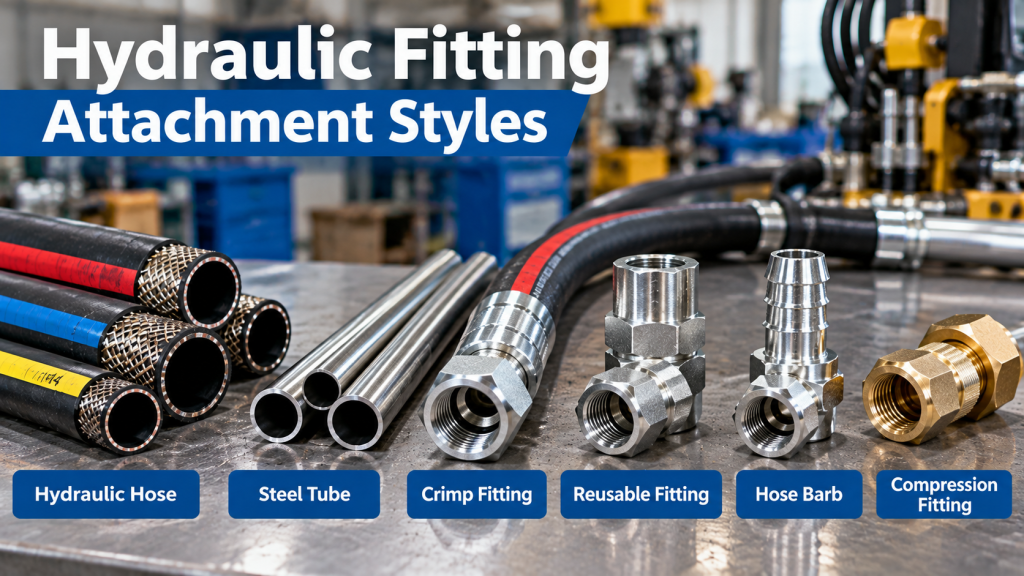
Hydraulic fitting attachment styles differ mainly in how they connect with hose or rigid tube, what installation equipment they require, and which pressure range or service condition they are designed for. Choosing the correct hydraulic fitting therefore requires you to identify the line type, pressure requirement, hose or tube construction, connection method, and maintenance conditions before ordering components.
Picture a repair shop servicing an excavator with a failed hydraulic line. A crimp fitting, reusable fitting, hose barb, and tube compression fitting may all appear capable of joining fluid lines, yet each uses a different attachment principle. Installing the wrong style can mean buying extra tools, rebuilding the assembly, delaying equipment repairs, or receiving components that cannot be used at all. Understanding these attachment methods gives distributors, maintenance companies, and equipment manufacturers a clearer purchasing path.
1. What Determines a Hydraulic Fitting Attachment Style?
A hydraulic fitting attachment style is determined by whether the connection joins flexible hose or rigid tube, its pressure range, and the assembly method available. You should identify these conditions before comparing fitting dimensions because two components with similar connection ends may attach to the fluid line in completely different ways.
Which application details should you identify?
Start with the actual fluid line. The attachment method becomes much easier to narrow down after you know what the fitting must connect with.
- Flexible hydraulic hose
- Steel hydraulic tube
- Stainless-steel tube
- Pressure line
- Suction line
- Return line
- Field repair or production assembly
A production hose shop may favor equipment-based assembly, while a remote maintenance crew may need a solution that can be installed using hand tools.
Why does the assembly location matter?
The work environment changes your options. A fitting that requires a dedicated machine may suit production but become inconvenient during an emergency repair far from a workshop.
- Check available assembly tools.
- Record operating pressure.
- Confirm hose or tube construction.
- Review service location.
- Consider replacement frequency.
Key Takeaway: Identify the fluid line and assembly environment before selecting an attachment style. This prevents you from ordering a fitting that matches the port but cannot be installed on the hose or tube.
| Selection Point | What to Check |
|---|---|
| Fluid line | Hose or rigid tube |
| Pressure | Pressure, return, or suction |
| Assembly site | Workshop or field |
| Equipment | Crimper or hand tools |
| Service need | Permanent or serviceable |
These checks provide a fast way to narrow the available fitting families.
2. How Does a Crimp Hydraulic Fitting Attach to Hose?
A hydraulic fitting using a crimp attachment connects to the hose through controlled compression of a ferrule around the hose and fitting stem. The assembly normally requires a compatible crimping machine, correct dies, and a specified finished crimp diameter.
Image brief: Photorealistic hydraulic crimping machine compressing a ferrule around a hose fitting, with fitting stem and hose clearly visible.
What does the crimping process require?
Here’s what controls the connection. The hose, fitting stem, ferrule, and machine setting must work as one assembly.
- Correct hose size
- Compatible fitting stem
- Matching ferrule
- Suitable crimp dies
- Specified crimp diameter
- Correct insertion depth
A production shop can document these variables and reproduce the same hose assembly across repeated orders.
Why are crimp fittings widely used?
Repeatability is the main attraction. Once the correct combination and machine settings are established, technicians can manufacture assemblies using a controlled process.
- Suitable for production quantities
- Consistent finished dimensions
- Broad pressure-line use
- Fast assembly with correct tooling
- Easy dimensional inspection
Key Takeaway: Crimp fittings make sense where you have suitable equipment and repeatable hose assembly specifications.
| Crimp Requirement | Purpose |
|---|---|
| Crimper | Applies controlled compression |
| Dies | Matches fitting diameter |
| Ferrule | Grips hose structure |
| Stem | Connects fitting with hose |
| Crimp value | Controls finished assembly |
A measured crimp provides stronger production control than appearance alone.
3. When Should You Use a Reusable Hydraulic Fitting?
A hydraulic fitting with a reusable or field-attachable design can be assembled without a conventional hydraulic crimping machine when used with a compatible hose. This makes the design useful for selected maintenance jobs where production equipment is unavailable.
Image brief: Photorealistic technician assembling a two-piece reusable hydraulic hose fitting using hand tools at a field maintenance location.
How does a reusable fitting work?
The construction is different from a crimped end. Many reusable designs use separate mechanical components that grip the hose as they are assembled.
- Hose-compatible socket
- Fitting nipple
- Mechanical tightening
- Correct insertion procedure
- Specified hose preparation
Assembly details can differ among fitting designs, so technicians should follow the applicable product instructions rather than assuming every reusable fitting works the same way.
Where can reusable fittings make sense?
Field service is the obvious use case. You may value a fitting that can be attached without moving the damaged machine or transporting a hose to a workshop.
- Remote construction sites
- Agricultural maintenance
- Mobile repair vehicles
- Emergency hose replacement
- Selected older machinery
Key Takeaway: Reusable fittings give you assembly flexibility, but only when hose and fitting compatibility has been confirmed.
| Factor | Reusable Fitting |
|---|---|
| Crimp machine | Not normally required |
| Assembly location | Workshop or field |
| Construction | Mechanical attachment |
| Hose match | Must be compatible |
| Typical value | Service flexibility |
The convenience disappears quickly if the fitting and hose were never designed to work together.
4. How Do Crimp and Reusable Hydraulic Fittings Compare?
A hydraulic fitting with a crimp attachment generally favors controlled production, while a reusable fitting favors assembly flexibility in compatible field-service applications. Neither attachment method should automatically be treated as better for every hydraulic system.
Image brief: Photorealistic side-by-side comparison of completed crimped and reusable hydraulic hose fittings with their assembly tools.
Which option suits production work?
Think about repeatability and volume. A hose shop producing repeated assemblies benefits from documented machine settings and inspection procedures.
- Faster repetitive assembly
- Controlled crimp dimensions
- Suitable for organized production
- Easier batch inspection
- Works with dedicated fabrication equipment
For distributors supplying finished assemblies, consistent production data can also simplify repeat orders.
Which option suits field maintenance?
Accessibility can change the answer. A compatible reusable design can reduce dependence on fixed workshop machinery.
- Easier remote assembly
- Fewer large tools
- Useful during selected emergency repairs
- Mechanical installation
- Convenient for low-volume service
Key Takeaway: Choose between crimped and reusable fittings according to your working environment, production volume, hose compatibility, and available equipment.
| Feature | Crimp | Reusable |
|---|---|---|
| Machine needed | Yes | Usually no |
| Production speed | High | Lower |
| Field assembly | Less convenient | Convenient |
| Repeatability | Machine controlled | Installer controlled |
| Hose compatibility | Required | Required |
Your attachment method should support the way your business actually builds and services hose assemblies.
5. When Should a Hydraulic Fitting Use a Barbed Connection?
A hydraulic fitting with a barbed attachment is generally associated with compatible lower-pressure hose applications such as certain suction or return lines rather than primary high-pressure hydraulic lines. The fitting stem enters the hose and relies on its barb geometry plus an approved retention method.
Image brief: Photorealistic hydraulic suction hose showing a barbed fitting, clamp, and large-diameter return-line hose on industrial equipment.
How does a barbed fitting attach?
The mechanism is easy to recognize. Raised barbs on the fitting stem provide mechanical grip against the hose interior.
- Insert barb into compatible hose.
- Position fitting at correct depth.
- Install approved clamp where required.
- Check hose condition.
- Inspect connection after assembly.
Some purpose-designed hose-and-fitting systems may use different retention methods, so you should verify the exact assembly requirements before installation.
Where are barbed fittings normally considered?
Pressure level matters here. These fittings can suit selected lines where working conditions differ from high-pressure pump or actuator circuits.
- Suction circuits
- Return lines
- Selected low-pressure fluid transfer
- Reservoir connections
- Compatible auxiliary systems
Key Takeaway: Do not substitute a hose barb for a pressure-line fitting merely because the hose dimensions appear compatible.
| Application | Barbed Fitting Suitability |
|---|---|
| High-pressure line | Generally not the target use |
| Return line | Common selected use |
| Suction line | Common selected use |
| Compatible low-pressure hose | Possible |
| Unknown hose | Verify before assembly |
Pressure classification should therefore come before fitting convenience.
6. How Should Barbed Hydraulic Fittings Be Secured?
A hydraulic fitting with a barbed hose stem should be secured using the retention method specified for the hose and fitting system. Depending on the application, this may involve an appropriate clamp or a hose-and-fitting design engineered around another attachment method.
Image brief: Photorealistic close-up comparing properly installed hose clamps on hydraulic suction and return hose barbed fittings.
What should you inspect before clamping?
A clamp cannot repair a poor component match. Inspect the hose and fitting before tightening anything.
- Correct hose ID
- Proper barb diameter
- Undamaged hose wall
- Clean fitting surface
- Correct insertion depth
- Suitable clamp type
An oversized hose or damaged hose wall can undermine the joint regardless of how tightly a clamp is installed.
Can overtightening create problems?
More clamp force is not always better. Excessive tightening may deform hose material or create an uneven load around the connection.
- Follow clamp guidance.
- Position the clamp correctly.
- Avoid cutting into hose cover.
- Check connection after installation.
- Reinspect during maintenance.
Key Takeaway: Barbed connections depend on correct hose dimensions, fitting geometry, and controlled retention rather than clamp force alone.
| Check | Desired Condition |
|---|---|
| Hose ID | Matches fitting |
| Barb | Correct diameter |
| Clamp | Suitable design |
| Position | Properly located |
| Hose wall | No damage |
Treat a barbed connection as an engineered assembly rather than a generic hose-and-clamp combination.
7. How Does a Compression Hydraulic Fitting Attach to Tube?
A hydraulic fitting using compression attachment joins rigid tube by mechanically compressing a ring or similar component against the tube and fitting body. This attachment method allows selected tube connections to be assembled without welding or a hydraulic hose crimper.
Image brief: Photorealistic exploded view of a steel hydraulic tube compression fitting showing nut, compression ring, fitting body, and tube.
How does compression attachment create a connection?
The sealing mechanism differs from hose fittings. Tightening the fitting causes the compression component to grip or conform against the tube.
- Prepare the tube correctly.
- Insert tube to specified position.
- Install compression components.
- Tighten according to instructions.
- Inspect alignment and sealing area.
Tube preparation and fitting design can affect final performance, so dimensions should be checked before assembly.
Why can compression fittings help field technicians?
Rigid tube work does not always happen inside a fabrication shop. Some compression systems allow technicians to make tube connections using portable hand tools.
- Machine repairs
- Tube replacement
- Field modifications
- Industrial maintenance
- Selected equipment installations
Key Takeaway: Compression fittings offer a mechanical attachment option for rigid tubing, while hydraulic hose fittings use attachment methods designed around flexible hose construction.
| Component | Function |
|---|---|
| Tube | Carries hydraulic fluid |
| Compression ring | Creates grip or seal |
| Nut | Applies assembly force |
| Fitting body | Connects tube to system |
| Port end | Joins mating component |
Knowing whether the fluid line is hose or tube prevents major purchasing mistakes.
8. How Do Hose and Tube Hydraulic Fittings Differ?
A hydraulic fitting intended for flexible hose attaches differently from a fitting designed for rigid steel or stainless-steel tube. Hose fittings must engage flexible hose construction, while tube fittings connect with a dimensionally stable metal line.
Image brief: Photorealistic hydraulic system showing flexible hose connection beside rigid steel tube connection with labels identifying each attachment area.
Why can’t you treat hose and tube fittings as identical?
Their attachment surfaces perform different jobs. Flexible hose contains layers that must be retained, while rigid tubing needs a fitting that grips or seals against solid metal.
- Hose uses flexible reinforcement.
- Tube retains fixed dimensions.
- Hose fittings may use ferrules.
- Tube fittings may use compression components.
- Preparation methods differ.
Even when both fittings terminate in the same JIC, BSP, or metric port style, the line-side attachment can remain completely different.
What should buyers specify in an RFQ?
A simple description prevents confusion. Tell the supplier what the fitting attaches to before discussing the opposite connection end.
- Hose or tube
- Hose ID or tube OD
- Material
- Pressure
- Port connection
- Quantity
Key Takeaway: Always specify both sides of a fitting—the attachment side and the connection side—when sourcing hydraulic components.
| Specification | Hose Fitting | Tube Fitting |
|---|---|---|
| Line | Flexible hose | Rigid tube |
| Size reference | Hose ID | Tube OD |
| Attachment | Crimp/reusable/barb | Compression or other tube method |
| Preparation | Hose cutting | Tube preparation |
| Tooling | Depends on style | Depends on style |
This distinction makes supplier communication much clearer.
9. Which Hydraulic Fitting Attachment Style Fits Your Application?
A hydraulic fitting attachment style fits your application only when it matches pressure level, line construction, assembly environment, available tooling, and maintenance strategy. Buyers should compare those factors before selecting a fitting solely because it is available in stock.
Image brief: Photorealistic engineering selection board comparing crimp, reusable, barb, and compression hydraulic connection methods with application icons.
What questions should you ask before ordering?
Use application questions rather than product assumptions.
- Is the line flexible hose or rigid tube?
- Is it a pressure, return, or suction line?
- Do you have a crimping machine?
- Will assembly happen in the field?
- What pressure must the line handle?
- Which hose or tube size is required?
These questions turn a vague fitting request into a usable technical specification.
How can distributors simplify fitting selection?
Build a repeatable identification process. Staff should record the same information for every unfamiliar connection.
- Photograph the complete assembly.
- Measure hose or tube size.
- Record thread specifications.
- Identify attachment style.
- Note pressure and application.
- Keep previous approved part numbers.
Key Takeaway: A structured selection process saves more time than searching for a supposed universal or standard fitting.
| Application Need | Likely Style to Evaluate |
|---|---|
| Production pressure hose | Crimp |
| Field-service hose | Reusable |
| Low-pressure hose | Barb |
| Rigid steel tube | Compression |
| Unknown line | Identify before ordering |
Selection becomes faster once attachment style is treated as a primary specification.
10. How Should Buyers Source Hydraulic Fitting Attachment Styles?
A hydraulic fitting should be sourced with enough technical information for the supplier to confirm attachment method, line size, port standard, material, pressure, and assembly requirements. Giving a supplier only a photo or generic fitting name creates unnecessary uncertainty.
Image brief: Photorealistic B2B hydraulic fitting sourcing desk with fitting samples, hose, steel tube, engineering drawings, calipers, RFQ sheet, and an attachment-style comparison chart.
What information should your supplier receive?
Give the supplier measurable data.
- Fitting attachment style
- Hose ID or tube OD
- Thread type and size
- Fitting configuration
- Working pressure
- Material
- Surface treatment
- Required quantity
- Drawing or physical sample
For custom requirements, dimensional drawings can make sample confirmation much faster.
How should you evaluate an alternative supplier?
Compare more than unit price. Attachment compatibility and production consistency have direct effects on field performance and replacement cost.
- Check sample dimensions.
- Verify thread quality.
- Review fitting materials.
- Confirm production capability.
- Compare lead times.
- Ask about OEM service.
Key Takeaway: Good sourcing begins with a complete attachment specification and ends with measurable sample approval.
| Supplier Check | B2B Purpose |
|---|---|
| Attachment compatibility | Prevent assembly errors |
| Dimensions | Confirm interchangeability |
| Material | Match application |
| Production capacity | Support repeat orders |
| Inspection | Maintain consistency |
| Technical response | Reduce sourcing time |
A clear specification gives both buyer and supplier the same definition of an acceptable fitting.
Final Thoughts
Hydraulic fitting attachment styles are not interchangeable simply because their connection ends look similar. Crimp fittings rely on controlled machine compression, reusable fittings support compatible field assembly, barbed fittings serve selected lower-pressure hose applications, and compression fittings provide a mechanical attachment method for rigid tube.
For distributors, equipment manufacturers, hydraulic repair businesses, and maintenance teams, understanding these differences solves several recurring problems: ordering fittings that cannot be assembled, applying low-pressure components in the wrong line, confusing hose fittings with tube fittings, and selecting products before checking available tooling.
TOPA supplies hydraulic fittings, adapters, hose ferrules, hydraulic hoses, and customized connection components for B2B customers. If you have an existing sample, hose specification, tube dimension, drawing, or unidentified attachment style, contact us today with the available technical details.
Our position is straightforward: reliable hydraulic connections begin with the right attachment method, accurate specifications, and components manufactured around the actual application.
FAQ
Can I replace a crimp fitting with a reusable fitting?
Sometimes, but only when the reusable fitting is designed for the specific hose and meets the application requirements. Do not assume equal thread and hose sizes make the components interchangeable.
What’s the best attachment style for hydraulic pressure hose?
Crimp fittings are widely used for professional pressure-hose assemblies. The correct choice still depends on hose construction, pressure, fitting compatibility, and assembly specifications.
How do I know if I need a barbed hydraulic fitting?
Check whether the line is a compatible lower-pressure suction, return, or fluid-transfer hose. Do not select a hose barb for a high-pressure line without a product specification supporting that use.
Can I install hydraulic hose fittings without a crimping machine?
Yes, if you are using a compatible field-attachable or reusable fitting system. Standard crimp fittings require suitable crimping equipment and assembly data.
What’s the difference between a hose fitting and a tube fitting?
A hose fitting attaches to flexible hydraulic hose, while a tube fitting attaches to rigid metal tubing. Their port ends may look similar, but their line-side attachment methods are fundamentally different.