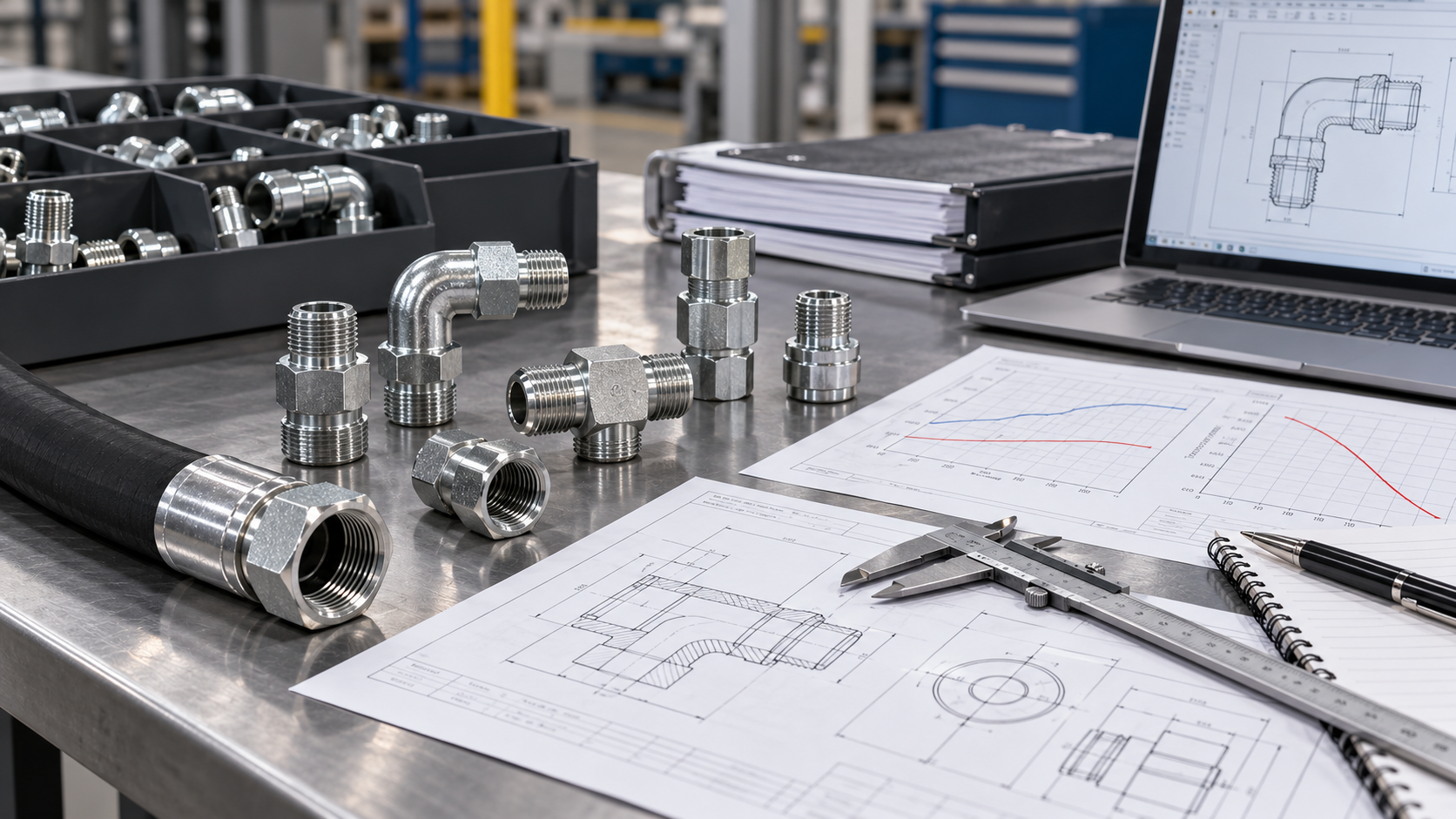
Choosing the right hydraulic hose fittings means matching hose size, connection type, sealing method, pressure, temperature, media, fitting material, and installation conditions. A hydraulic fitting may look like a small component, but the wrong choice can create leaks, downtime, damaged equipment, or an unsafe hose assembly.
Imagine your maintenance team needs to replace a damaged hose on an excavator before the next shift. Several fittings in your stockroom appear almost identical, yet one uses a different sealing surface and another has a different pressure rating. Selecting fittings through a structured process helps you avoid those mistakes and gives purchasing teams a repeatable method for future orders.
1. How Do You Start Selecting a Hydraulic Fitting?
A hydraulic fitting should be selected only after you define the hose size, temperature, application, media, and pressure requirements. These five factors give you a practical starting point before you compare threads, materials, or fitting shapes.
Image brief: Photorealistic hydraulic hose assembly workstation with hose, fittings, calipers, pressure specification sheet, and maintenance technician.
What information should you collect first?
Here’s where good selection starts. Write down the application conditions before contacting a supplier or searching a catalog.
- Hose inside diameter
- Working pressure
- Maximum temperature
- Hydraulic fluid
- Equipment type
- Connection standard
- Installation environment
For B2B buyers, this information also makes RFQs clearer and reduces repeated questions during quotation.
Why should you treat the hose as a complete assembly?
This point changes how you purchase. Hose, fitting, ferrule, sealing surface, and crimp specification must work together rather than simply fit together physically.
- Confirm hose series.
- Match fitting size.
- Verify pressure ratings.
- Check sealing geometry.
- Review assembly specifications.
Key Takeaway: Start with operating conditions rather than a fitting photograph. This gives you a much stronger basis for identifying and purchasing the correct connection.
| Selection Factor | What to Confirm |
|---|---|
| Size | Hose and fitting dimensions |
| Temperature | Operating range |
| Application | Equipment conditions |
| Media | Fluid compatibility |
| Pressure | Working requirement |
This information narrows the fitting options before detailed identification begins.
2. Which Hydraulic Fitting Material Should You Choose?
A hydraulic fitting material should match pressure requirements, corrosion exposure, temperature, fluid compatibility, and purchasing budget. Carbon steel, stainless steel, brass, and some specialized materials serve different operating environments.
Image brief: Photorealistic comparison of carbon-steel, stainless-steel, and brass hydraulic fittings arranged on a professional inspection table.
When should you choose carbon steel?
For many industrial systems, this is the practical option. Carbon steel provides a useful balance between strength, availability, manufacturing flexibility, and cost.
- Construction machinery
- Agricultural equipment
- Industrial hydraulic systems
- Mobile equipment
- General maintenance applications
Surface treatments can also improve corrosion resistance for common working environments.
When are stainless steel or brass better?
Your operating environment makes the difference. Stainless steel becomes attractive where corrosion resistance receives greater priority, while brass may suit selected lower-pressure or specialized applications.
- Stainless steel for corrosive environments
- Stainless steel for chemical applications
- Brass for selected fluid systems
- Brass for moderate-pressure applications
- Special materials for unusual media
Key Takeaway: Select fitting material according to real operating conditions instead of appearance or price alone.
| Material | Common Purchasing Consideration |
|---|---|
| Carbon steel | Strength and cost balance |
| Stainless steel | Corrosion resistance |
| Brass | Selected lower-pressure use |
| Special alloys | Extreme environments |
Correct material selection can extend component life and reduce maintenance frequency.
3. Which Hydraulic Fitting Type Fits Your Hose?
A hydraulic fitting generally falls into a permanent crimped design or a field-attachable design. Your choice depends on hose compatibility, assembly equipment, maintenance conditions, and whether the connection must be assembled away from a hose workshop.
Image brief: Photorealistic split image showing a crimped hydraulic hose fitting on one side and a reusable field-attachable fitting on the other.
How do permanent crimp fittings work?
This is the standard approach for many hose shops. A crimping machine compresses the ferrule around the hose and fitting stem according to a specified crimp diameter.
- Suitable for production assemblies
- Requires a hydraulic crimper
- Uses specified dies
- Creates a permanent connection
- Supports repeatable production
Crimped fittings remain common because they allow controlled assembly when the correct hose, fitting, ferrule, and crimp data are used.
When should you consider field-attachable fittings?
Sometimes your service location changes the decision. Field-attachable fittings can help when suitable hose systems are used and a crimping machine is unavailable.
- Remote repair work
- Emergency maintenance
- Selected service vehicles
- Older equipment
- Compatible field-service hose systems
Key Takeaway: Never choose between crimped and reusable fittings based on convenience alone. Confirm the hose was designed for the selected fitting system.
| Fitting Type | Assembly Method | Typical Situation |
|---|---|---|
| Crimped | Hydraulic crimper | Production assembly |
| Field attachable | Mechanical installation | Field maintenance |
| Reusable | Manual assembly | Selected repair systems |
Fitting construction must remain compatible with the hose design.
4. How Does Sealing Affect Hydraulic Fitting Selection?
A hydraulic fitting must use a sealing method compatible with its mating connection. Threads may provide mechanical engagement while an O-ring, flare, cone, or tapered thread creates the actual fluid seal.
Image brief: Photorealistic technical comparison of JIC flare, ORFS flat-face O-ring, BSP, and tapered pipe hydraulic connections.
Which sealing systems should you recognize?
This is where similar-looking fittings become very different. Identifying the sealing surface often tells you more than thread diameter alone.
- O-ring face seal
- Flared metal seat
- Cone seal
- O-ring boss
- Tapered pipe thread
Never assume two connections are compatible simply because one thread can start inside another.
Why can overtightening cause problems?
More force does not always create a better seal. Excessive tightening may damage threads, sealing surfaces, or fitting bodies.
- Follow specified torque.
- Inspect sealing faces.
- Replace damaged O-rings.
- Avoid repeated forced tightening.
- Verify the connection standard.
Key Takeaway: Identify where the connection seals before deciding whether two fittings are compatible.
| Seal Type | Main Sealing Area |
|---|---|
| ORFS | Flat face and O-ring |
| JIC | Flared metal seat |
| ORB | O-ring at port |
| Tapered thread | Thread interface |
Correct sealing identification helps prevent recurring leaks.
5. How Does Pressure Affect Hydraulic Fitting Choice?
A hydraulic fitting must have a pressure rating suitable for the complete hose assembly and the actual operating conditions. System pressure, pressure spikes, fitting size, hose construction, and connection style should all be reviewed together.
Image brief: Photorealistic high-pressure hydraulic test bench with hose assembly, fitting, pressure gauge, and protective enclosure.
Why should you check more than normal pressure?
Hydraulic systems rarely operate in perfectly steady conditions. Temporary pressure spikes can place extra stress on hoses and fittings.
- Record normal operating pressure.
- Check maximum system pressure.
- Consider pressure surges.
- Review equipment duty cycle.
- Verify component ratings.
Your finished assembly should never depend on a fitting whose rating falls below application requirements.
Does connection design influence pressure performance?
Yes, and this matters during specification. Different sealing systems, materials, dimensions, and fitting constructions may carry different allowable ratings.
- Compare fitting specifications.
- Check hose pressure rating.
- Confirm ferrule compatibility.
- Review connection type.
- Verify assembly data.
Key Takeaway: Treat pressure as an assembly requirement rather than a fitting-only specification.
| Pressure Factor | Buyer Check |
|---|---|
| Working pressure | Normal operation |
| Pressure spikes | Peak conditions |
| Hose rating | Compatible with fitting |
| Connection | Suitable design |
| Assembly data | Approved combination |
A well-matched assembly gives maintenance teams a more predictable service result.
6. How Does Vibration Affect a Hydraulic Fitting?
A hydraulic fitting operating in a high-vibration environment requires careful routing, connection selection, inspection, and support. Repeated movement can contribute to loosening, hose fatigue, abrasion, or stress near the fitting.
Image brief: Photorealistic hydraulic hoses and fittings installed on vibrating construction machinery with proper clamps and routing.
Which applications need extra attention?
Mobile machinery is a good example. Excavators, loaders, agricultural machines, and industrial equipment can expose connections to continuous mechanical movement.
- Excavators
- Wheel loaders
- Tractors
- Mining machinery
- Industrial presses
- Mobile hydraulic equipment
Inspect these areas more frequently when hoses operate near moving structures.
How can routing reduce vibration problems?
A good fitting cannot correct poor routing. Hose installation should minimize unnecessary twisting, sharp bending, rubbing, and side loading.
- Follow minimum bend radius.
- Avoid hose twisting.
- Use suitable clamps.
- Leave room for movement.
- Protect abrasion points.
Key Takeaway: Fitting selection and hose routing should be considered together when equipment experiences frequent movement.
| Vibration Issue | Possible Effect |
|---|---|
| Loose connection | Leakage |
| Hose twisting | Premature fatigue |
| Abrasion | Cover damage |
| Side loading | Fitting stress |
| Poor clamping | Excessive movement |
Proper routing can help the hose assembly perform more consistently in mobile applications.
7. How Does Temperature Change Hydraulic Fitting Selection?
A hydraulic fitting must remain suitable for the temperatures experienced by its material, plating, seals, hose, and hydraulic fluid. High or low temperatures can affect more than the metal fitting body alone.
Image brief: Photorealistic hydraulic hose connection operating near hot industrial machinery with temperature monitoring equipment.
Which components are affected by temperature?
This is easy to overlook during purchasing. Several materials inside one connection may have different allowable temperature ranges.
- Hose inner tube
- Hose cover
- O-ring
- Fitting material
- Surface coating
- Hydraulic fluid
An application may therefore be limited by its least temperature-resistant component.
Why should you check seal temperature limits?
Seals deserve special attention. Excessive heat can harden, soften, or damage elastomeric components and may eventually lead to leakage.
- Check seal material.
- Review fluid temperature.
- Consider ambient heat.
- Watch for nearby exhaust systems.
- Confirm cold-temperature performance.
Key Takeaway: Evaluate temperature across the complete connection rather than checking only the metal fitting.
| Temperature Check | Component |
|---|---|
| Fluid temperature | Hose and seal |
| Ambient heat | Hose cover |
| Extreme cold | Elastomer performance |
| Heat source | Routing |
| Material limit | Fitting body |
Temperature data should appear in your technical purchasing requirements.
8. Why Does Fluid Compatibility Matter for a Hydraulic Fitting?
A hydraulic fitting must work with seals, hose materials, and components that are chemically compatible with the fluid passing through the system. Compatibility becomes especially significant when systems carry specialized oils, chemicals, gases, or nonstandard fluids.
Image brief: Photorealistic hydraulic fitting, hose, O-rings, and several labeled industrial fluid samples on an engineering laboratory bench.
What components should you compare with the fluid?
Think beyond the fitting body. Every wetted material can influence system performance.
- Hose inner tube
- O-ring
- Fitting material
- Plating
- Adapter
- Sealant where applicable
A connection may mechanically fit while still being unsuitable for the media inside the system.
What should B2B buyers tell suppliers?
More application information produces better quotations. Give suppliers fluid details before requesting material recommendations.
- Hydraulic oil type
- Chemical exposure
- Operating temperature
- Pressure
- Environmental conditions
- Cleaning chemicals
Key Takeaway: Chemical compatibility should be confirmed before bulk ordering, especially when you source fittings for unfamiliar fluids or new equipment.
| Component | Compatibility Check |
|---|---|
| Hose tube | Fluid resistance |
| O-ring | Seal material |
| Fitting | Base material |
| Plating | Chemical exposure |
| Adapter | Matching material |
This information helps your supplier avoid inappropriate material combinations.
9. Why Does Hydraulic Fitting Availability Matter?
A hydraulic fitting should provide the required technical performance while remaining practical to replace or stock. Availability becomes a purchasing issue when an uncommon connection causes long lead times and unexpected equipment downtime.
Image brief: Photorealistic hydraulic fittings warehouse with organized bins, common thread types, inventory labels, and B2B stock management environment.
Should you consider standard fittings first?
For many businesses, standardization saves money. Commonly used connection families may be easier to stock and reorder across multiple machines.
- Identify frequently used sizes.
- Standardize compatible connections.
- Maintain emergency stock.
- Track consumption.
- Review replacement lead times.
Distributors can also use these records when planning inventory around customer demand.
When should you stock special fittings?
Some equipment gives you no choice. If a machine uses an uncommon fitting, keeping a small replacement quantity may cost less than waiting during a breakdown.
- Long supplier lead time
- Imported machinery
- Customized connections
- Critical production equipment
- High downtime cost
Key Takeaway: Availability does not replace technical compatibility, but it should influence inventory strategy once the correct fitting has been identified.
| Inventory Factor | Purchasing Action |
|---|---|
| Common fitting | Maintain routine stock |
| Critical fitting | Keep safety stock |
| Long lead time | Order ahead |
| Custom fitting | Record drawings |
| Frequent replacement | Increase inventory |
Good inventory planning converts fitting availability into shorter maintenance response time.
10. Can You Mix Different Hydraulic Hose Fittings?
A hydraulic fitting should not be mixed with an unrelated hose, ferrule, or crimp specification merely because nominal sizes appear identical. Stem geometry, ferrule dimensions, hose reinforcement, tolerances, and crimp values can vary between component systems.
Image brief: Photorealistic hydraulic quality-control station comparing two similar fittings and hose assemblies using calipers, drawings, and crimp specifications. Include an engineering comparison chart.
Why can similar components fail together?
Tiny dimensional differences matter under pressure. A connection may appear correct while the stem and ferrule do not grip the hose as intended.
- Stem diameter can vary.
- Ferrule dimensions can differ.
- Hose OD can change.
- Crimp specifications may not match.
- Reinforcement construction can differ.
This makes component compatibility a technical issue rather than simply a brand or price comparison.
How should you qualify an alternative supplier?
This is particularly relevant for importers and distributors. Compare measurable specifications before approving replacement products.
- Provide existing samples.
- Send dimensional drawings.
- Confirm hose specifications.
- Review crimp data.
- Test samples.
- Record approved combinations.
Key Takeaway: Alternative sourcing can work well when compatibility is verified through specifications and testing instead of assumptions.
| Qualification Item | What to Compare |
|---|---|
| Thread | Standard and size |
| Stem | Dimensions |
| Ferrule | Geometry |
| Hose | ID, OD, construction |
| Crimp | Finished diameter |
A documented qualification process gives you greater flexibility without sacrificing assembly consistency.
Final Thoughts
Choosing the correct hydraulic hose fittings requires more than identifying thread size. You should consider hose dimensions, fitting material, connection type, sealing method, pressure, vibration, temperature, chemical compatibility, availability, and hose-to-fitting compatibility before approving a part.
For distributors, equipment manufacturers, maintenance workshops, and hydraulic service businesses, this process solves a practical purchasing problem: turning an uncertain fitting requirement into a clear technical specification that can be quoted, inspected, reordered, and used consistently.
TOPA supplies hydraulic fittings, adapters, ferrules, hydraulic hoses, and customized connection components for international B2B customers. If you have a sample, drawing, thread measurement, or hose specification and need help matching the correct connection, contact us today with your available technical information.
Reliable hydraulic connections begin with accurate specifications, compatible components, and a supplier that understands how your fittings will actually be used.
FAQ
Can I choose hydraulic hose fittings by thread size alone?
No. Thread size is only one identification point. You should also confirm thread pitch, sealing method, seat geometry, hose size, pressure rating, and fitting configuration.
What’s the best hydraulic fitting material for most equipment?
Carbon steel works well for many general industrial hydraulic systems because it provides a practical balance between strength and cost. Stainless steel may be more suitable where corrosion resistance has greater priority.
How do I know if a hydraulic fitting matches my hose?
Check hose ID, OD, construction, pressure rating, fitting stem, ferrule, and approved crimp specification. Matching nominal size alone does not prove compatibility.
Can I use different hydraulic hose and fitting suppliers?
Yes, but only after compatibility has been technically verified. Compare dimensions, hose construction, ferrule design, crimp values, pressure requirements, and test results before approving the combination.
What’s the best way to identify an unknown hydraulic fitting?
Start with clear photographs and measure thread diameter, pitch, seat angle, fitting configuration, and hose size. Providing those measurements with an existing sample or drawing gives your supplier a much better basis for identification.